
Technical Resources · Selection Guide
DC Fuse Selection Guide: Voltage, Current, Class and Breaking Capacity
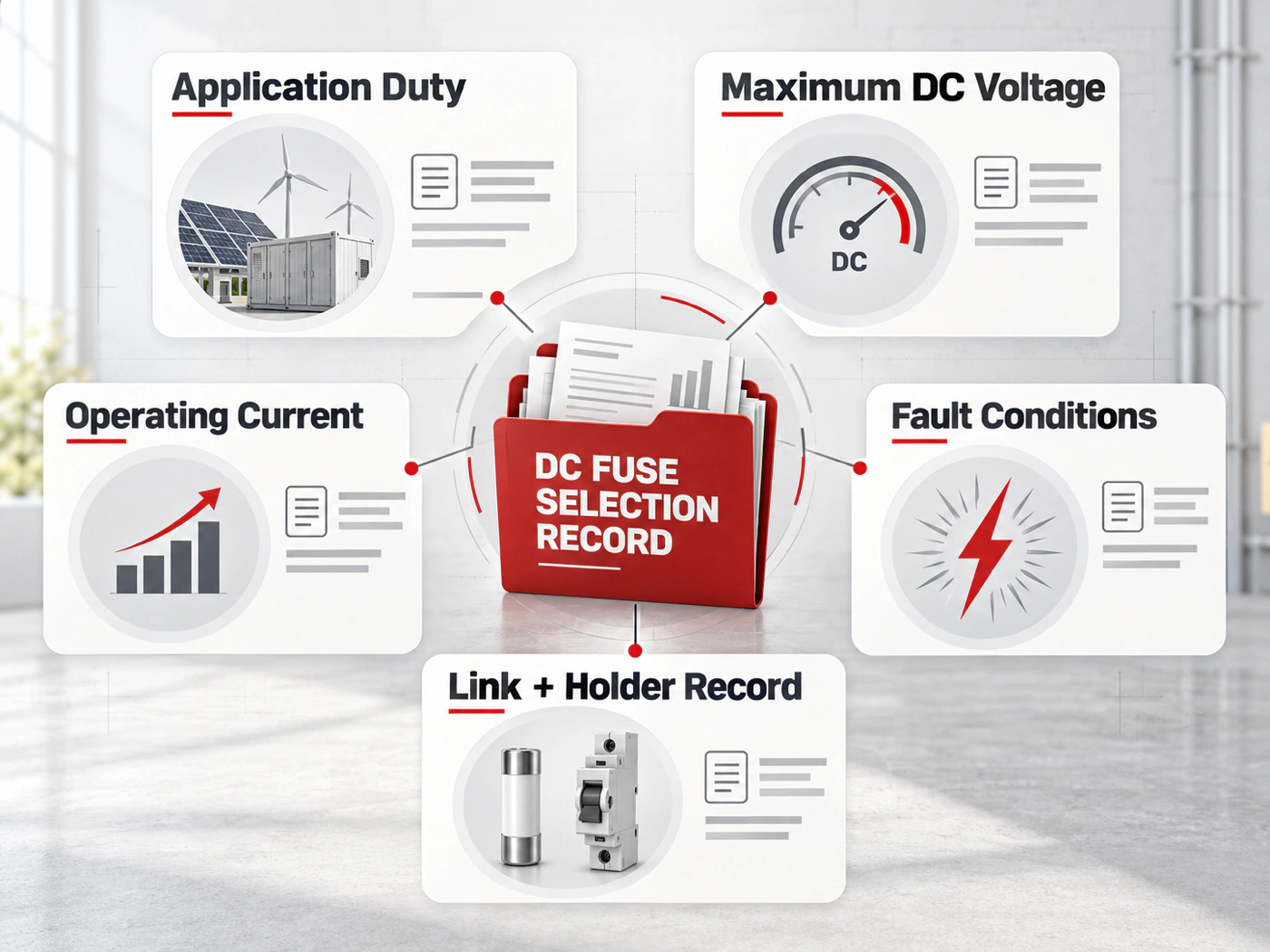
Buying a DC fuse link is not simply choosing a cartridge that fits a holder. A technically useful offer must match the circuit application, voltage, continuous current, prospective fault conditions and the precise fuse-link/holder arrangement. A purchase request that says only “DC fuse, 10x38” leaves the supplier to guess the utilization category, interrupting duty and compatible holder.

This guide owns the information needed to specify a DC fuse link. It does not decide whether a fuse or a resettable circuit breaker is preferable, and it does not treat the gPV designation as a complete selection rule. Use the separate comparison and designation guides for those questions. The project designer supplies the circuit record; the exact manufacturer documents establish the proposed link and holder.
Selection Factors at a Glance
| Factor | Buyer input | Evidence required |
|---|---|---|
| Application | PV string, array, or another identified DC circuit | Utilization category documented for that duty |
| Voltage | Maximum voltage under the relevant operating conditions | Exact fuse-link DC rated voltage |
| Normal current | Continuous operating current and applicable temperature conditions | Link current rating and manufacturer application guidance |
| Fault conditions | Prospective fault current and protection objective | Documented breaking and operating characteristics |
| Mechanical fit | Link format, holder and mounting conditions | Exact holder/link pairing and both components’ ratings |
Define the Circuit and Protection Objective
Describe the source and what the fuse is intended to protect. A PV string or array has a different context from an unspecified battery or power-electronics circuit. Record maximum voltage, expected current and the fault conditions the designer has assessed. Do not derive the fault current from the fuse current marking. If the existing system has a holder, identify its exact model and documentation; visual similarity is not enough.
Ask whether the request is for a replacement link in a verified assembly or a newly designed protective arrangement. For a replacement, the original approved link and holder records matter; for a new design, the relevant equipment and installation requirements must be assessed. This article cannot determine whether a fuse is required in a particular PV string layout. The answer depends on system design and applicable rules, not a generic number of strings copied from a manufacturer example.
Interpret Voltage, Current and Fuse Category Separately
The DC voltage rating describes the link’s documented application envelope; a physical size does not establish it. The current rating is not the same thing as a recommended system operating current. Temperature, enclosure and operating conditions may affect a manufacturer’s application guidance. Ask for the exact link curve or selection data rather than inventing a universal derating multiplier.
A utilization category identifies the type of duty for which a fuse link is intended. Mersen’s photovoltaic technical note describes gPV as general-purpose fuse-link scope for PV applications under the IEC 60269-6 context. It does not follow that a gPV link is the answer for any DC circuit. Nor does the gPV mark itself prove a particular RITOKS model’s certification, voltage, current or breaking capacity. Keep the designation, exact model rating and project application as separate fields.
Check Breaking and Operating Evidence
A fuse must be evaluated against the fault conditions it may be required to interrupt. Compare the prospective fault level and circuit voltage with the exact link’s manufacturer documentation. For a PV application, ask whether low available fault currents and the relevant operating curve have been considered by the responsible designer. The Mersen note discusses PV fault behavior and DC interruption as a general teaching source; its example numbers are not RITOKS ratings.
A quotation can include a curve, minimum and rated breaking information, and conditions for the stated performance. Do not borrow one link’s characteristic for a different physical size or product family. If the seller supplies only a headline breaking-capacity figure, request the associated voltage, application category and document revision before comparing offers.
Keep Fuse Link and Holder as Two Documented Parts
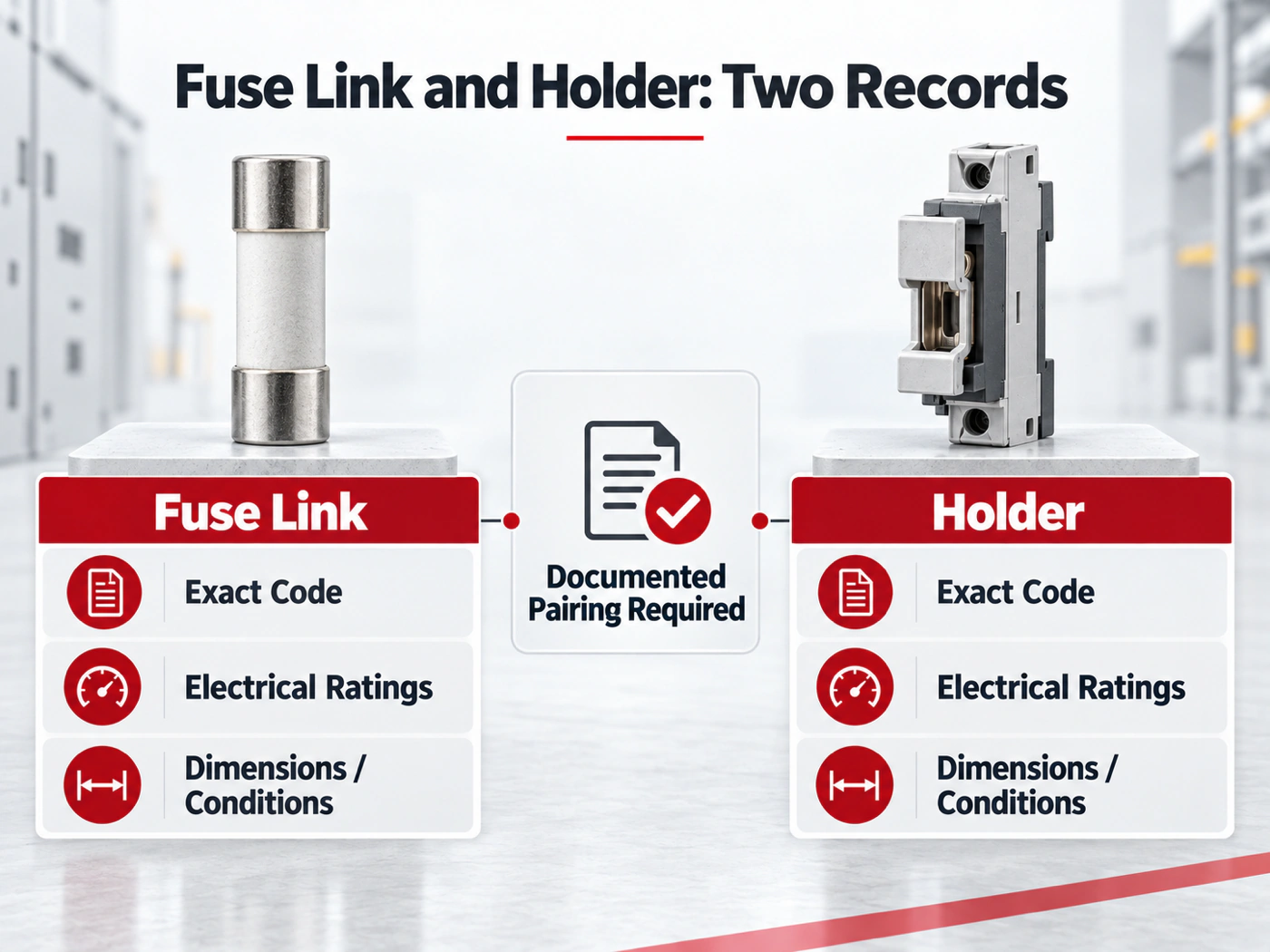
A link that physically enters a holder has not automatically formed a compliant assembly. Record the holder’s exact code, DC voltage and current ratings, environmental limits, terminal and mounting requirements, and manufacturer-supported link format. The link’s dimensions, contact geometry and heat dissipation also belong in the review. Do not state that two RITOKS products are compatible merely because their nominal cartridge sizes match.
When comparing offers, distinguish a link-only price from a link-plus-holder assembly. If the project already has a holder, request written confirmation of exact link compatibility rather than substituting a visually similar cartridge. If a holder is proposed with the fuse, ask the supplier to identify both orderable codes and their individual data sheets.
Compare Offers Without Combining Their Best Figures
| Comparison item | Offer A | Offer B |
|---|---|---|
| Duty/category | Exact application and marked category | Exact application and marked category |
| Link electrical record | Voltage, current and breaking data at relevant conditions | Voltage, current and breaking data at relevant conditions |
| Operating evidence | Exact curve and document revision | Exact curve and document revision |
| Holder record | Exact model and supported link pairing | Exact model and supported link pairing |
A missing holder record is an unresolved comparison point, not a reason to assume compatibility. If one offer is for a PV-specific link and another is for a different duty, identify the category difference before comparing price. The decision depends on the application record and exact documents, not on which cartridge carries a higher printed current.
Buyer Workflow and RFQ Checklist
- Record source type, circuit location, protection objective and whether this is a replacement or a new design.
- Provide maximum DC voltage, normal current, assessed fault conditions and environmental constraints.
- Specify the required utilization category or ask the manufacturer to confirm the appropriate category against the application.
- Request exact link code, DC ratings, breaking and operating data, dimensions and documentation revision.
- Identify the existing holder or request a separately documented holder recommendation and compatibility evidence.
- State quantity, destination and any known project review requirements; leave unknown engineering inputs explicitly open.
Published RITOKS Examples
RITOKS publishes distinct 10x38 1000V and 10x65 1500V gPV fuse-link families. Those page titles describe separate published product records, not a combined rating range. Read each configuration row on its own terms. A buyer who needs a non-PV DC fuse should not assume either PV-specific example is suitable; request the application evidence first.
Separate Replacement Work From New Design
A replacement inquiry begins with the existing approved assembly. Record the fuse-link code, holder code, equipment nameplate and the document that established the original pairing. If the original link is obsolete, a proposed substitute needs its own voltage, current, utilization category, breaking and operating characteristics plus written holder compatibility. Matching cartridge dimensions are useful for identification, but they do not preserve the electrical or thermal behavior of the previous assembly.
A new design starts from the circuit and protection objective instead. The designer determines the conditions the fuse must address and whether a fuse is the appropriate protective architecture. Procurement then compares exact links and holders against that record. Keeping these two workflows separate avoids a common error: treating an acceptable replacement procedure as proof that the same component is appropriate for a different source, enclosure or protection objective.
Control Evidence Through Quotation and Delivery
Ask each supplier to return one evidence package with the quotation: orderable link code, exact datasheet revision, characteristic information, dimensions, holder code and the documented pairing. If the offer includes a family table, highlight the selected row rather than copying values into a new sheet without their conditions. Record whether the quoted quantity covers links only, holders only or complete assemblies, and identify any spares separately.
At delivery, verify the received markings and part numbers against the approved record without treating packaging or appearance as technical proof. Any substitution, changed holder or revised documentation should return to review before installation. The buyer checklist therefore continues beyond price comparison: it protects the traceability of the exact selection from RFQ through receipt while leaving application approval with the responsible technical parties.
For spare-parts planning, record whether the requested quantity includes operating stock, commissioning spares or future replacements, but do not change the technical selection to simplify inventory. A common cartridge size can support logistics while still requiring separate exact-model records. The spare list should therefore repeat the approved link and holder codes rather than using only a generic size description. Retain the document revision with that list.
Frequently Asked Questions
Does 10x38 identify the voltage or fuse class?
No. It describes a nominal physical format. Check the exact link’s DC electrical ratings, category and supported holder separately.
Can I use any holder with a link of the same size?
No. Request the exact holder/link compatibility record and both components’ ratings. Mechanical insertion is not a complete electrical approval.
Is a gPV fuse suitable for every DC source?
No. The gPV designation concerns PV fuse-link duty. Other DC applications require their own protection assessment and exact manufacturer evidence.
Related RITOKS Products and Guidance
Use these pages as separate product and family records. A link is not a claim that two devices are interchangeable or coordinated.
DC fuse versus circuit breaker comparison
Technical References
The following manufacturer sources support the general concepts identified below. Their model ratings, diagrams and approvals do not transfer to RITOKS products.
Mersen, Photovoltaic Market: Over-current Protection
Supports the general PV-specific gPV designation and discussion of DC/PV interruption conditions. The note is not a RITOKS product datasheet or a current certification record.
Request an Exact-Model Review
Send the recorded application requirements, exact documentation questions, quantity and destination through the RITOKS contact form. An RFQ requests an exact-model review; this guide does not approve a wiring design or recommend an automatic substitute.