
Technical Resources · Comparison
AC-3 vs AC-4 Contactor Utilization Categories: Verification Guide
AC-3 and AC-4 are utilization categories that describe different motor-switching duties. They are not interchangeable current labels. A buyer must describe how the motor is started and stopped, then check the exact contactor rating and operating limits for that duty.
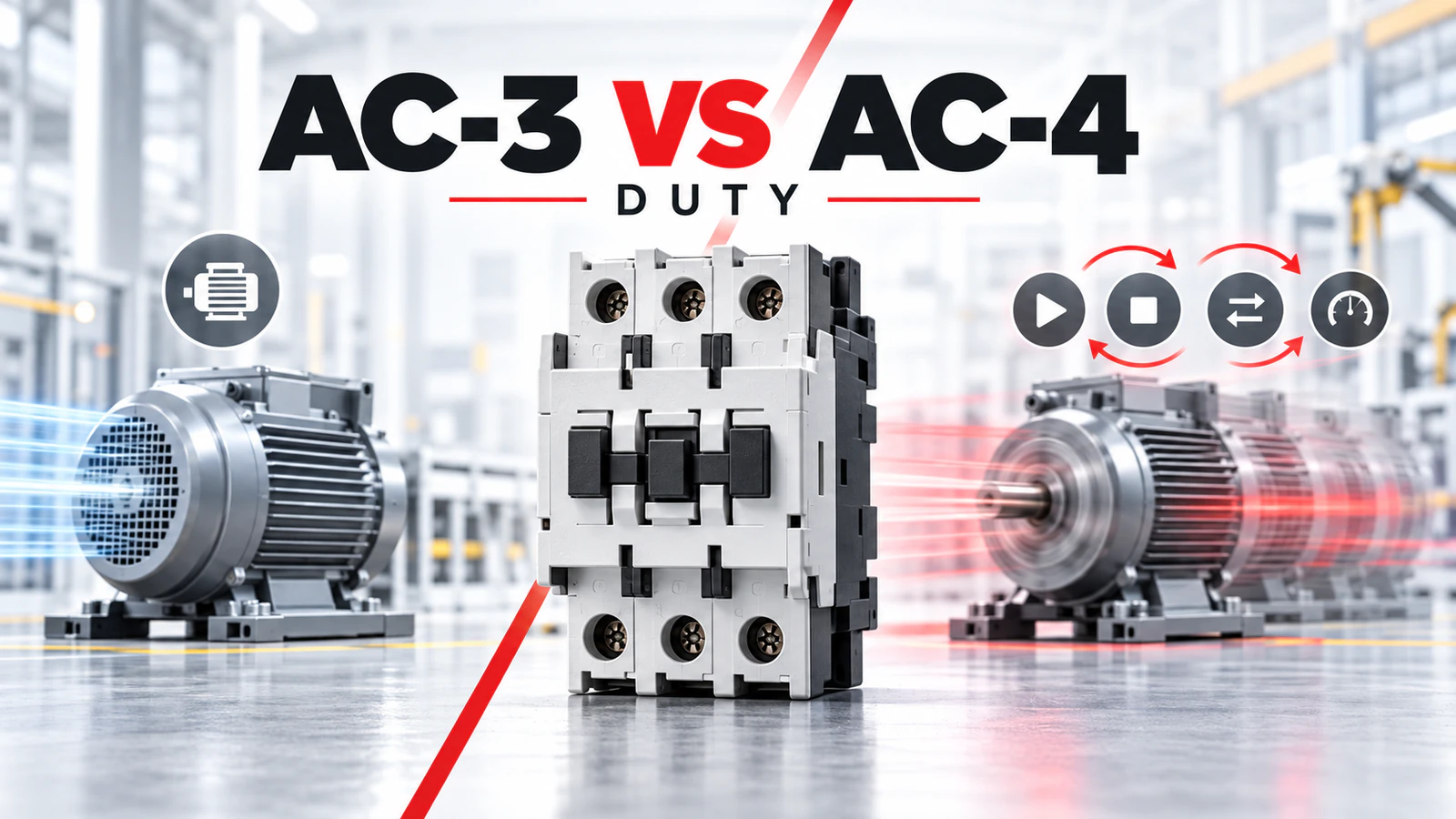
This article owns the AC-3 versus AC-4 duty distinction. It does not duplicate the general contactor selection guide or assert that every ZS3TF model has the same AC-4 rating or endurance.
Buying Decision at a Glance
| Decision input | Buyer must confirm | Evidence required |
|---|---|---|
| Motor/load | Motor type and nameplate data | Exact category applicability |
| Operating duty | Normal stop, reversing, plugging or inching | AC-3 or AC-4 table row |
| Current | Operational current under that duty | Exact Ie rating for voltage/category |
| Frequency | Starts, stops and operations per hour | Documented operating-frequency limits |
| Life requirement | Expected mechanical and electrical operations | Exact endurance data |
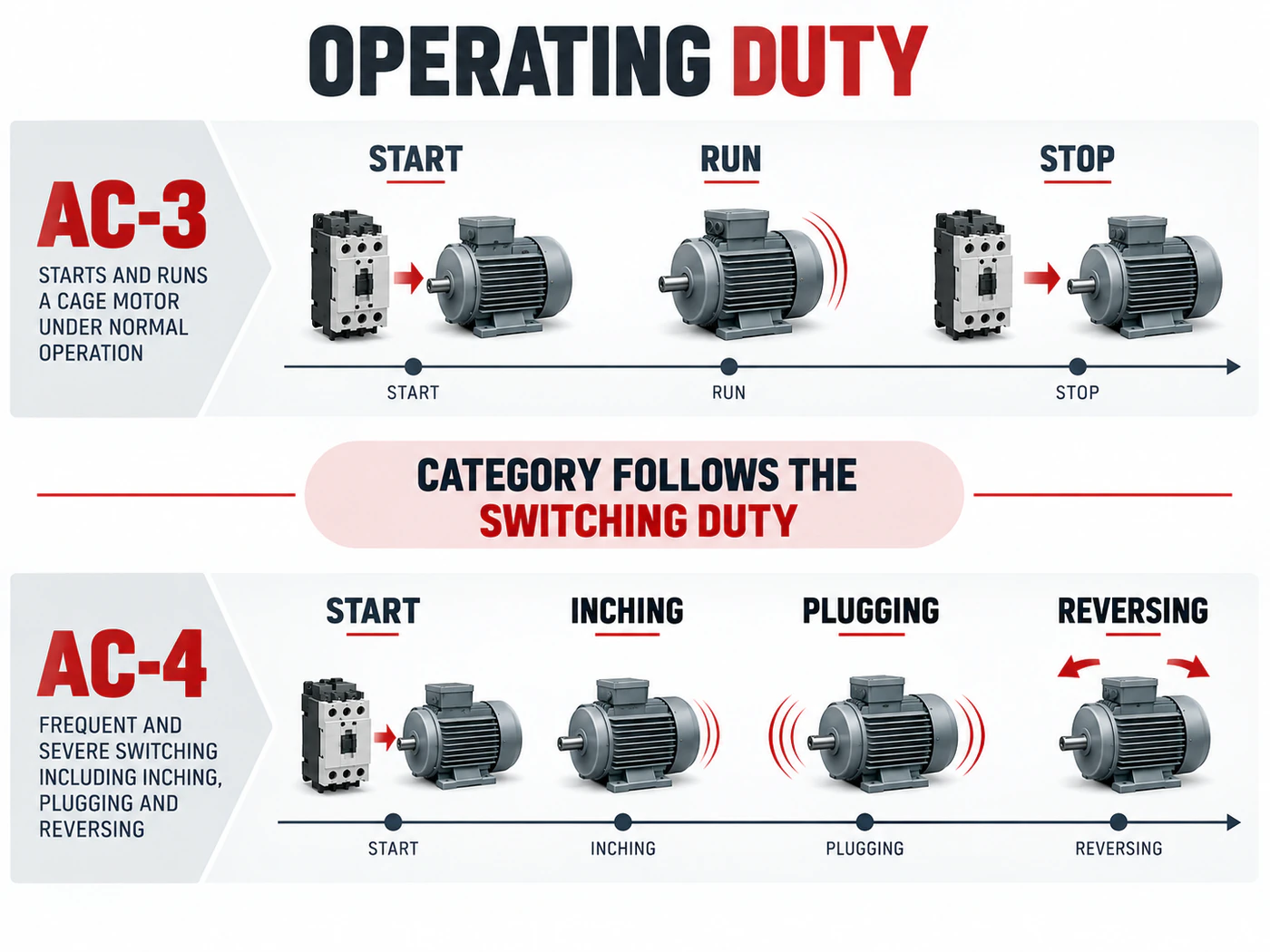
Utilization Category Describes Duty
Schneider Electric defines AC-3 for squirrel-cage motor starting and switching off during normal running. AC-4 covers more severe operating duty such as plugging and inching. The category tells the reader what making and breaking conditions are being evaluated; it is not a general quality grade.
A project that normally starts a motor and stops it after it is running should not be described as AC-4 merely to request a stronger product. Conversely, an application that repeatedly inches or plugs the motor should not be quoted from an AC-3 current column. Describe the actual operating sequence.
Do Not Transfer Current Ratings Between Columns
A contactor can have different operational-current ratings under AC-3 and AC-4 because the interruption duty is different. Compare the exact model, voltage and utilization-category row. The family maximum and model name do not replace that table.
The ZS3TF source record contains separate AC-3 and AC-4 values for documented models at 380V. Those values remain model-specific. A buyer must not infer a missing AC-4 value from a nearby model or apply a 380V figure to another voltage without evidence.
Frequency and Endurance Matter
A contactor that can perform one operating duty is not automatically suitable for the required number of operations. Request the documented switching frequency and electrical endurance under the intended category. Include expected operations per hour and service pattern in the RFQ.
Distinguish mechanical endurance from electrical endurance. Mechanical operations do not prove contact life while switching the specified motor duty. Where a source omits a value for a model, leave it unknown and ask the manufacturer rather than propagating another model’s figure.
Build a Comparable Quotation
Give each supplier the same motor voltage, current, start/stop sequence, reversing or inching requirement, operations per hour, coil supply and auxiliary-contact needs. Request the exact contactor code and category-specific table.
If the duty changes during commissioning, return the contactor selection to review. A higher motor current, more frequent operations or a move from normal stopping to plugging can change the relevant rating even when the enclosure and terminals look unchanged.
Build an Evidence File Before Approval
Create one review sheet for the proposed AC Contactor order code. Put the application inputs in the left column and the supplier evidence in the right column. At minimum, preserve the records for motor/load, operating duty, current and frequency and life requirement. This makes it clear which information comes from the project and which statement comes from the manufacturer.
Attach the exact datasheet pages, drawings and tables used in the decision. Record their revision or retrieval date and highlight the row for the quoted model. A sales email can clarify scope, but it should not silently replace a technical document when the decision depends on a rating, connection, trip characteristic, thermal limit or tested combination.
Check that every linked value describes the same orderable configuration. Similar model names often share a housing while differing in control supply, current band, poles, terminals, accessories or environmental limits. If a document covers several variants, mark the selected row rather than treating the broadest range on the page as the capability of every variant.
Control Changes During Sourcing
Keep the application record frozen while suppliers prepare quotations. If voltage, load, duty, fault level, enclosure or operating method changes, issue a revised record and ask each supplier to reconfirm the candidate. Otherwise procurement may compare responses that were prepared for different requirements even though the email subject and product family are unchanged.
Apply the same rule to substitutions. A replacement proposed because of price or availability returns to the technical gate with its own order code and evidence. Do not approve it solely because the nominal current, product shape or mounting method resembles the original candidate. The substitution is complete only when the required functions and conditions are rechecked.
Common Procurement Errors
- Selecting AC Contactor from one headline rating while leaving the application context undefined.
- Using a diagram, curve or accessory table from a neighboring model without confirming scope.
- Treating a product-category page or marketing image as exact-model evidence.
- Comparing a device-only quotation with an assembled or accessory-inclusive quotation.
- Allowing an unresolved technical field to disappear when the commercial offer is revised.
Resolve these errors before commercial comparison. The technical reviewer should be able to trace each accepted statement to the project record or to the exact candidate document without relying on memory. Procurement can then compare price, quantity, destination and lead time against a stable technical baseline instead of reopening the selection after order placement.
How to Compare Supplier Offers
Compare every AC Contactor offer against one frozen application record. Do not combine the best figures from several variants or accept a family maximum as the rating of the quoted order code. Keep the document revision, test conditions and unresolved fields beside each value so procurement can see whether two offers are genuinely equivalent.
| Comparison point | Required evidence | Do not accept |
|---|---|---|
| Motor operation | AC-3: start and switch off during running | AC-4: start, plugging and inching duty |
| Rating source | Exact AC-3 row | Exact AC-4 row |
| Operating frequency | Verify for exact model and duty | Verify for exact model and duty |
| Endurance | Electrical life under AC-3 | Electrical life under AC-4 |
| Substitution | No automatic transfer | No automatic transfer |
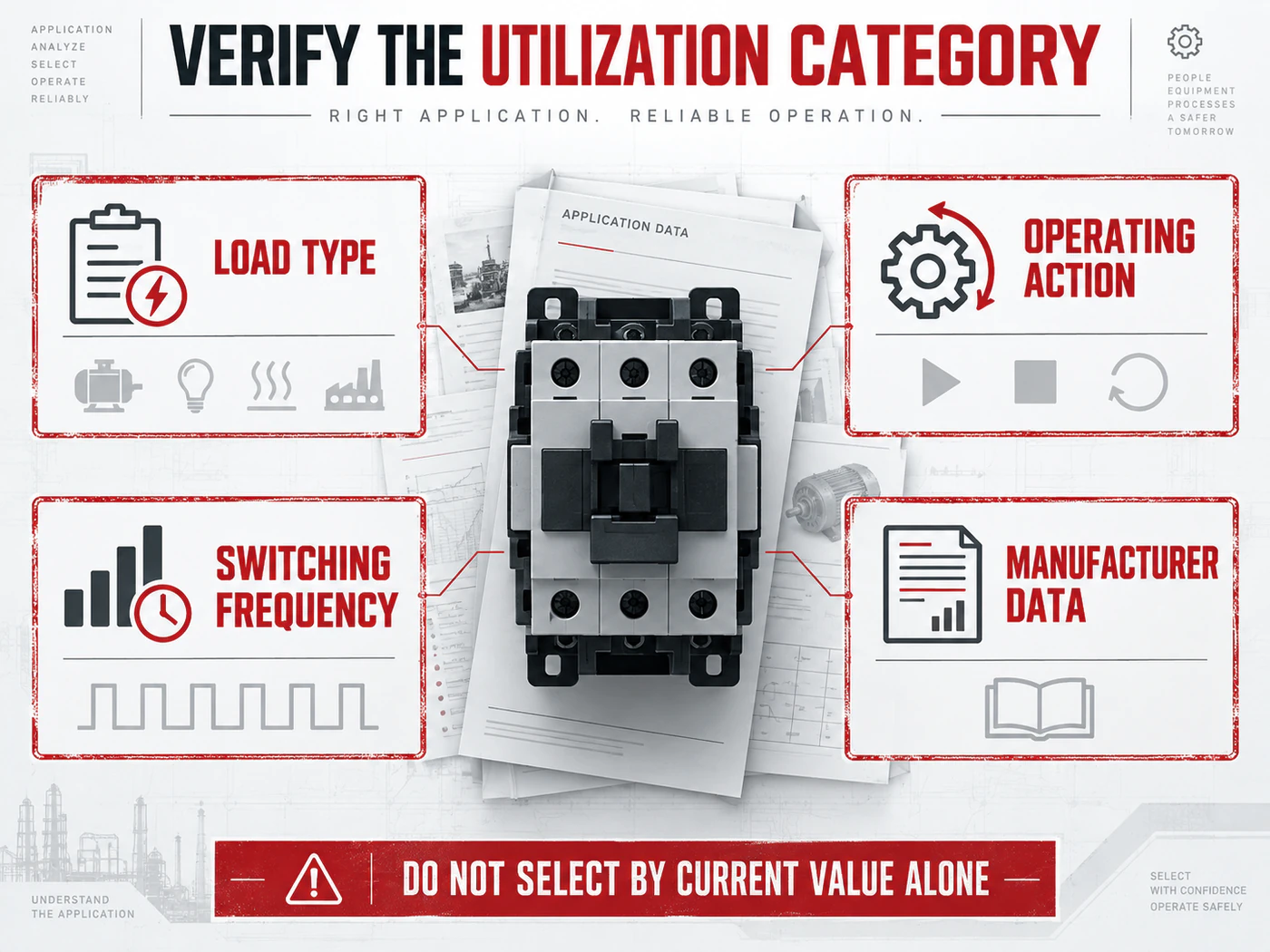
A quotation can remain commercially interesting while technically incomplete. Mark missing data as an open action and ask the supplier for the exact page, drawing or combination table. Price and lead time should be compared only after the technical scope is normalized. This prevents a lower-cost but narrower offer from appearing equivalent to a complete documented solution.
Decision Workflow
- Describe the actual motor operating sequence.
- Identify whether normal running stop, inching, plugging or reversing occurs.
- Record voltage, motor current and operations per hour.
- Request category-specific current and endurance data for the exact model.
- Confirm coil and auxiliary requirements separately.
- Recheck selection if duty or frequency changes.
At each step, preserve the boundary between project inputs and supplier evidence. The project team defines the application and required functions; the supplier identifies an exact product and provides its documents. Neither side should fill an evidence gap by inference from appearance, a nearby model or a shared headline rating.
RFQ Preparation Checklist
A useful RFQ for ac3 vs ac4 contactor should be concise enough to answer but complete enough to prevent silent assumptions. Attach the available project record and identify unknown values as questions. Ask the supplier to answer with an exact orderable code rather than a generic product-family recommendation.
- Motor type, voltage and nameplate current
- Start/stop and reversing/inching sequence
- Expected operations per hour
- Required utilization category
- Exact category-specific current and endurance table
- Coil and auxiliary contacts
- Quantity and destination
Request the current datasheet revision and identify the scope of any certification, coordination or compatibility claim. If the response proposes a substitute, require the same evidence set for that substitute. Record quantity and destination after the technical inputs so commercial terms do not obscure unresolved engineering questions.
Stop Conditions Before Order Release
Do not release the order while a publication-critical input is unknown, the quoted model is ambiguous, or a required rating is supported only by another manufacturer’s document. Stop as well when a combination claim lacks exact component codes or when a diagram is being reused across product families. These are evidence gaps, not editorial details.
The final approval record should state what the selected item does, what remains outside its scope and which exact documents support the decision. If the application, duty, environment or proposed model changes, reopen the relevant checks rather than carrying the previous conclusion forward.
Frequently Asked Questions
Is AC-4 simply a higher rating than AC-3?
No. It describes a different and generally more severe operating duty, not a generic quality level.
Can I use the AC-3 ampere value for inching?
Not without exact manufacturer evidence. Inching belongs to the AC-4 duty definition.
Does the model name reveal its AC-4 rating?
No. Read the exact category and voltage row for that orderable model.
Related RITOKS Products and Guidance
Use these links as separate category, product and educational records. A contextual link does not claim interchangeability, compatibility or a coordinated combination.
Technical References
The following authoritative sources support only the general concepts stated below. Their product values, diagrams, combinations and approvals do not transfer to RITOKS products.
Schneider Electric, TeSys Giga Utilization Categories
Defines AC-3 and AC-4 by load and operating duty. It does not establish a RITOKS model rating.
Schneider Electric, Information Required to Select a Contactor
Separates main contacts, auxiliary contacts, coil and enclosed-starter scope. Schneider options are not RITOKS product specifications.
Request an Exact-Model Review
Send the recorded application requirements, exact documentation questions, quantity and destination through the RITOKS contact form. An RFQ requests an exact-model review; this guide does not approve a wiring design, installation or automatic substitute.