
Power Semiconductor Modules · Selection Guide
MDS Bridge Rectifier Module Selection Guide: Current Range, Load Type and Model Verification
Selecting an MDS bridge rectifier module is not simply a matter of choosing the next current number in a product table.
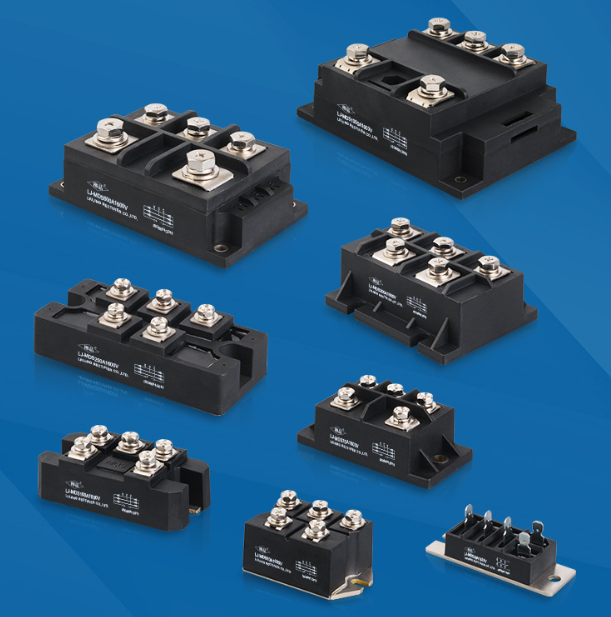
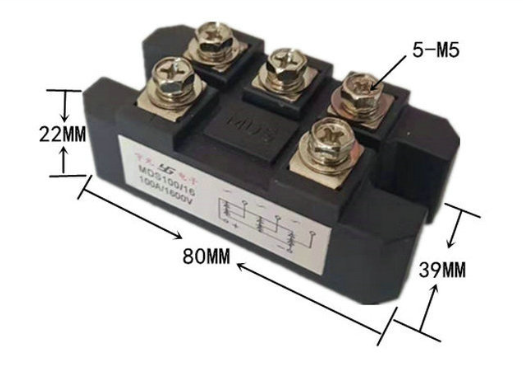
A practical sourcing process starts by identifying the electrical and application requirements already defined for the project, then comparing those requirements with the published module family and confirming the exact model before ordering.
RITOKS currently publishes two MDS three-phase bridge rectifier module families:
- MDS 30A–250A Three-Phase Bridge Rectifier Module
- MDS 300A–1200A High Current Three-Phase Bridge Rectifier Module
Together, these families provide published current classes from 30A to 1200A.
However, current class alone is not enough to establish final suitability.
Voltage version, operating conditions, load characteristics, cooling arrangement and exact model documentation should also be verified.
Contents
MDS Bridge Rectifier Module Selection at a Glance
| Selection Input | What to Check |
|---|---|
| Required current class | Compare the project requirement with the published MDS model range |
| Voltage requirement | Confirm the exact voltage suffix/version before ordering |
| Load characteristics | Provide the actual application and load information rather than assuming one universal current relationship |
| Cooling arrangement | Review the supplier reference thermal information and confirm the actual heatsink/cooling design |
| Exact model | Confirm the complete orderable model, not only the current class |
| Mechanical fit | Request package, mounting and dimensional information where required |
| Documentation | Confirm required drawings, model data and other technical documents before production |
This checklist is for product-family selection and RFQ preparation.
It is not an electrical or thermal sizing calculator.
1. Start With the Two Published MDS Current Families
MDS 30A–250A Family
Published current classes include:
- 30A
- 60A
- 75A
- 100A
- 150A
- 200A
- 250A
This family provides the lower-current portion of the current RITOKS MDS range.
MDS 300A–1200A Family
Published current classes include:
- 300A
- 400A
- 500A
- 600A
- 800A
- 1000A
- 1200A
This family extends the published MDS range into higher current classes.
The distinction is useful for narrowing the candidate family.
It does not mean that a required load current can automatically be converted into an MDS model number without further verification.
2. Current Class Is a Starting Point, Not the Complete Selection
Bridge rectifier manufacturers normally specify several electrical and thermal parameters rather than relying on current rating alone.
For example, the Vishay bridge-module portfolio and parametric selection distinguishes industry parameters such as reverse voltage, average forward current, surge current, junction-temperature limits, package and circuit configuration.
For a RITOKS MDS inquiry, the current class can therefore be used to narrow the product family, but the exact model should still be checked against the complete project requirement.
Do not interpret:
100A module
as meaning:
suitable for every application with a 100A load.
Those are not equivalent statements.
3. Confirm the Exact Voltage Version
The current product-family pages identify the MDS families and current classes, but the exact voltage version should be confirmed for the required model.
A buyer should therefore provide:
Required voltage: [project requirement]
and ask RITOKS to confirm:
Exact MDS model / voltage suffix: [to be confirmed]
Do not assume that every published current class is available in every possible voltage configuration.
Do not infer the voltage from:
- the module photograph
- the current number
- another MDS model
- a supplier reference table
- a similar product from another manufacturer
The exact variant is the unit that needs to be verified.
4. Treat Load Type as an Application Input
The type of load and operating conditions can affect how a rectifier is evaluated.
For procurement purposes, buyers should provide the actual application context rather than trying to convert it into a universal sizing formula.
Useful information may include:
- rectification application
- load description
- expected operating current
- operating pattern
- available cooling arrangement
- relevant project electrical requirements
The RITOKS product pages contain supplier-reference load-current information.
That information can help with preliminary family review, but it should remain reference information, not a universal engineering rule.
Different power-electronics operating conditions can change losses and thermal behavior, so semiconductor selection and cooling need to be considered under the actual operating conditions. Semikron Danfoss application guidance specifically treats component selection and thermal management as application-dependent engineering tasks.
5. Do Not Convert the Supplier Reference Table Into a Formula
A common sourcing mistake is to take a reference table and derive an unofficial rule such as:
Load current × fixed factor = required bridge rectifier current.
This article does not recommend such a formula.
The published supplier-reference tables for the RITOKS MDS families should be used only within their stated context.
They should not be turned into:
- a universal derating percentage
- a universal safety margin
- a current multiplier
- a server or machine sizing rule
- an overload allowance
- a fuse-selection rule
If the application needs engineering calculations, they should be based on the actual circuit, operating conditions and verified device data.
6. Thermal Verification Matters
Power-semiconductor losses produce heat, and thermal conditions are part of determining whether a device can operate within its permitted limits. Industry application guidance treats semiconductor rating and cooling as linked considerations and requires the thermal design to keep the device within its allowed junction-temperature conditions.
Both current RITOKS MDS product families include supplier-reference heatsink information.
That can help identify what needs to be discussed during selection.
But it does not establish a complete thermal design for every project.
The buyer should still confirm:
- actual operating conditions
- cooling method
- heatsink arrangement
- mounting interface
- ambient conditions where relevant
- exact model thermal documentation
Do not assume that a reference heatsink automatically guarantees the required semiconductor temperature in a different system.
7. MDS 30A–250A vs MDS 300A–1200A
| Published Item | MDS 30A–250A | MDS 300A–1200A |
|---|---|---|
| Product family | Three-phase bridge rectifier module | High-current three-phase bridge rectifier module |
| Published current classes | 30 / 60 / 75 / 100 / 150 / 200 / 250A | 300 / 400 / 500 / 600 / 800 / 1000 / 1200A |
| Supplier load-current reference | Published | Published |
| Supplier heatsink reference | Published | Published |
| Exact voltage version | Confirm exact model | Confirm exact model |
| Package dimensions | Not currently published | Not currently published |
| Terminal details | Not currently published | Not currently published |
| Mounting drawing | Not currently published | Not currently published |
| Certification evidence | Not currently published | Not currently published |
| Downloadable model datasheet | Not currently published | Not currently published |
For an exact family-level view, see the MDS 30A–250A vs 300A–1200A comparison; final model selection still requires more than the current number.
8. When the 30A–250A Family May Be the First Family to Review
The MDS 30A–250A family is the logical first product family to review when the project requirement falls within one of its published current classes:
30A through 250A.
That does not mean the nearest current class is automatically the correct orderable module.
Before ordering, confirm at least:
- required electrical rating
- exact voltage version
- application/load information
- thermal arrangement
- exact model designation
- any required mechanical documentation
The purpose of this step is to narrow the sourcing discussion, not to replace engineering verification.
9. When the 300A–1200A Family May Be the First Family to Review
The MDS 300A–1200A family becomes the relevant published family when the project requires review of one of the higher current classes:
300A through 1200A.
Again, this should not be read as:
required load current = same-number module automatically.
Instead:
project requirement → candidate MDS family → exact model verification
is the safer workflow.
The higher published current range also does not make this family universally “better” than the 30A–250A family.
They address different sourcing requirements.
10. Do Not Rank the Two Families by Current Alone
A 1200A-class product is not simply a better version of a 100A-class product.
Higher current class can also bring different requirements around:
- system design
- cooling
- mechanical integration
- protection
- documentation
The correct family is the one that matches the actual project requirements and verified model data.
Avoid statements such as:
- choose the largest current rating for more safety
- a higher-current bridge runs cooler
- more current capacity always means longer life
- oversizing by a fixed percentage is recommended
The current RITOKS evidence does not support those universal rules.
11. What Information Should Be Confirmed Before Ordering?
Several important fields are not currently published in enough detail for every MDS model.
Exact Voltage Version
Confirm the complete voltage/version designation.
Dimensions
Request the drawing if enclosure or heatsink fit is important.
Terminal Arrangement
Do not determine terminal assignments from product photography.
Request the exact technical information for the selected model.
Mounting
Confirm the required mechanical and heatsink interface.
Thermal Information
Use supplier-reference data as a starting point, then verify the actual application.
Certification or Standards
If a project requires specific certificates, approvals or test evidence, request those documents explicitly.
A standard name, certificate and test report are not interchangeable.
12. A Practical MDS Selection Workflow
A conservative sourcing workflow is:
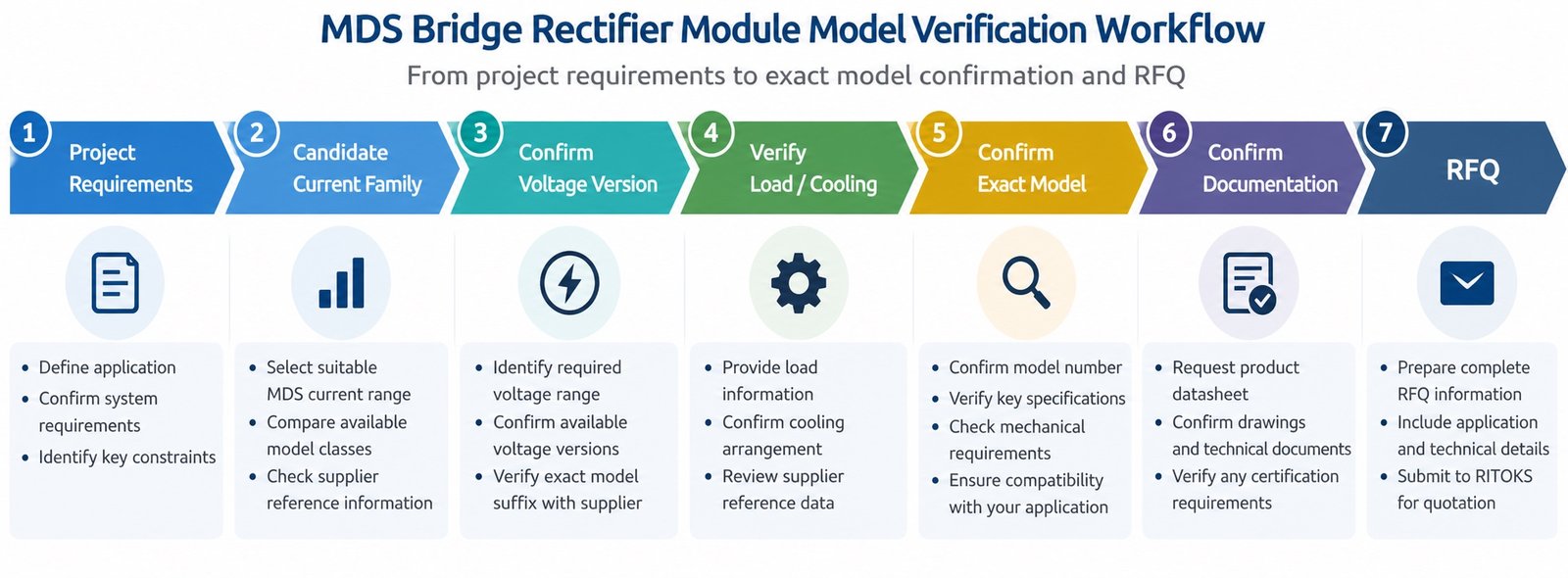
This sequence avoids treating one published number as a complete engineering decision.
13. What Not to Infer From the Product Image
The current MDS product photography is useful for identifying the product family.
It should not be used as technical evidence for:
- terminal function
- internal circuit
- voltage rating
- insulation rating
- exact dimensions
- mounting dimensions
- current rating
- certification
Those details require published model information or supplier confirmation.
14. Information to Include in an MDS Bridge Rectifier RFQ
A useful inquiry can include:
- Application: [application]
- Required current: [requirement]
- Required voltage: [requirement]
- Load information: [description]
- Cooling arrangement: [known requirement]
- Preferred MDS current class: [if known]
- Required dimensions/drawing: [if required]
- Required technical documents: [list]
- Quantity: [quantity]
- Destination: [country / region]
- Required delivery: [schedule]
If a field has not yet been defined, write:
To be confirmed
rather than inventing a value.
A dedicated Bridge Rectifier Module RFQ Checklist can be added later if the procurement intent proves distinct enough from this selection guide.
Frequently Asked Questions
What Current Ranges Are Published for RITOKS MDS Bridge Rectifier Modules?
RITOKS currently publishes one MDS family covering 30A–250A current classes and another covering 300A–1200A.
Can I Choose an MDS Module Only From the Load Current?
No universal selection rule is established by the current product data.
Current class is one selection input. Exact voltage, operating conditions, cooling and model documentation should also be verified.
Does RITOKS Publish Heatsink Information?
The two current MDS product pages contain supplier-reference heatsink information.
It should be treated as reference data rather than a complete thermal-design guarantee.
Are All Voltage Versions Confirmed?
No.
The exact voltage version should be confirmed for the exact MDS model required.
Are Package Dimensions and Terminal Drawings Published?
The current product pages do not provide complete package, mounting and terminal drawings for every listed model.
Request them when required for integration.
Does a Higher Current Class Mean a Better Bridge Rectifier?
No.
The two families cover different published current ranges. Selection depends on matching the complete project requirement to an exact model.
Need Help Selecting an MDS Bridge Rectifier Module?
Start with the project requirements already known:
- current requirement
- voltage requirement
- application/load information
- cooling conditions
- required documentation
- quantity
Then compare the requirement with the two published MDS families and confirm the exact model before ordering.
Related Resources
Continue exploring Power Semiconductor Modules
Diode Rectifier Module Selection Guide: Current, Voltage, Configuration and Model Verification
Selecting a diode rectifier module starts with a defined electrical and mechanical requirement, not with a family name…
Read guide
SCR Thyristor Module Selection Guide: Current Class, Voltage, Cooling and Model Verification
Selecting an SCR thyristor module requires more than matching a current number to a product name. A practical…
Read guide