
AC Power Protection · Comparison
1P+N vs 2P Circuit Breakers: Configuration Questions for Buyers
When buyers compare 1P+N and 2P circuit breakers, the first difference they notice is the pole designation. But the label alone does not tell you everything about how a specific breaker handles the neutral conductor, how many poles are protected, whether switching is simultaneous, or whether the device is intended to provide a particular isolation function.
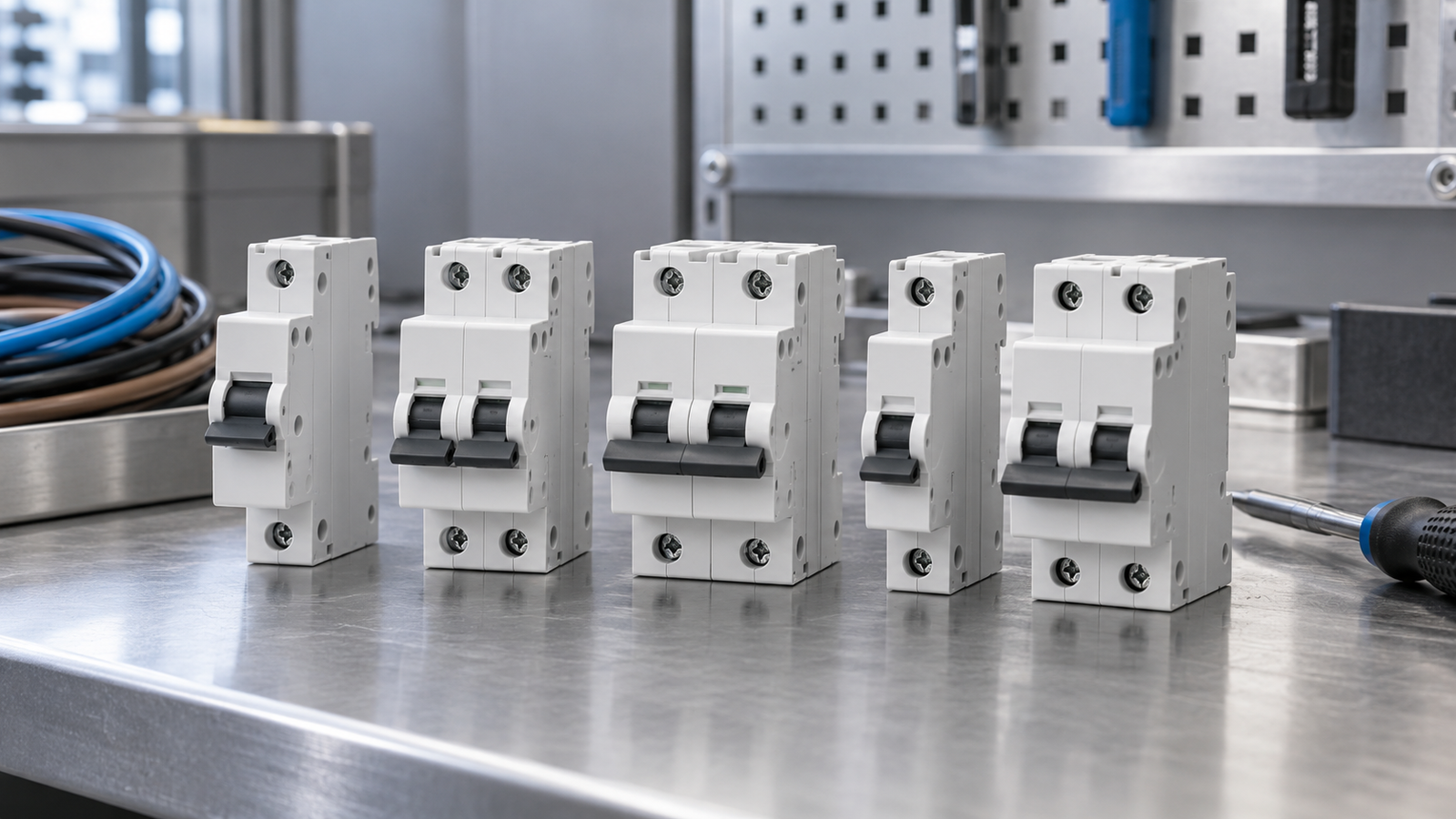
Different manufacturers can document these configurations in different ways. The safer buyer question is not simply, “Is 1P+N or 2P better?” It is: “What does the exact manufacturer document for this configuration, and does that match the project requirement?”
Contents
Quick Comparison: 1P+N vs 2P
| Configuration | What the Label Safely Tells You | What Still Needs Verification |
|---|---|---|
| 1P+N | The product is offered as a phase-plus-neutral configuration | Which pole is protected, neutral switching behavior, mechanism, module width and isolation function |
| 2P | The product is offered as a two-pole configuration | Protection behavior of each pole, conductor assignment, switching arrangement, mechanism and application requirements |
The important distinction is: pole designation is not the same as complete internal-behavior documentation. A buyer should verify the exact model rather than relying only on the letters printed in a catalog title.
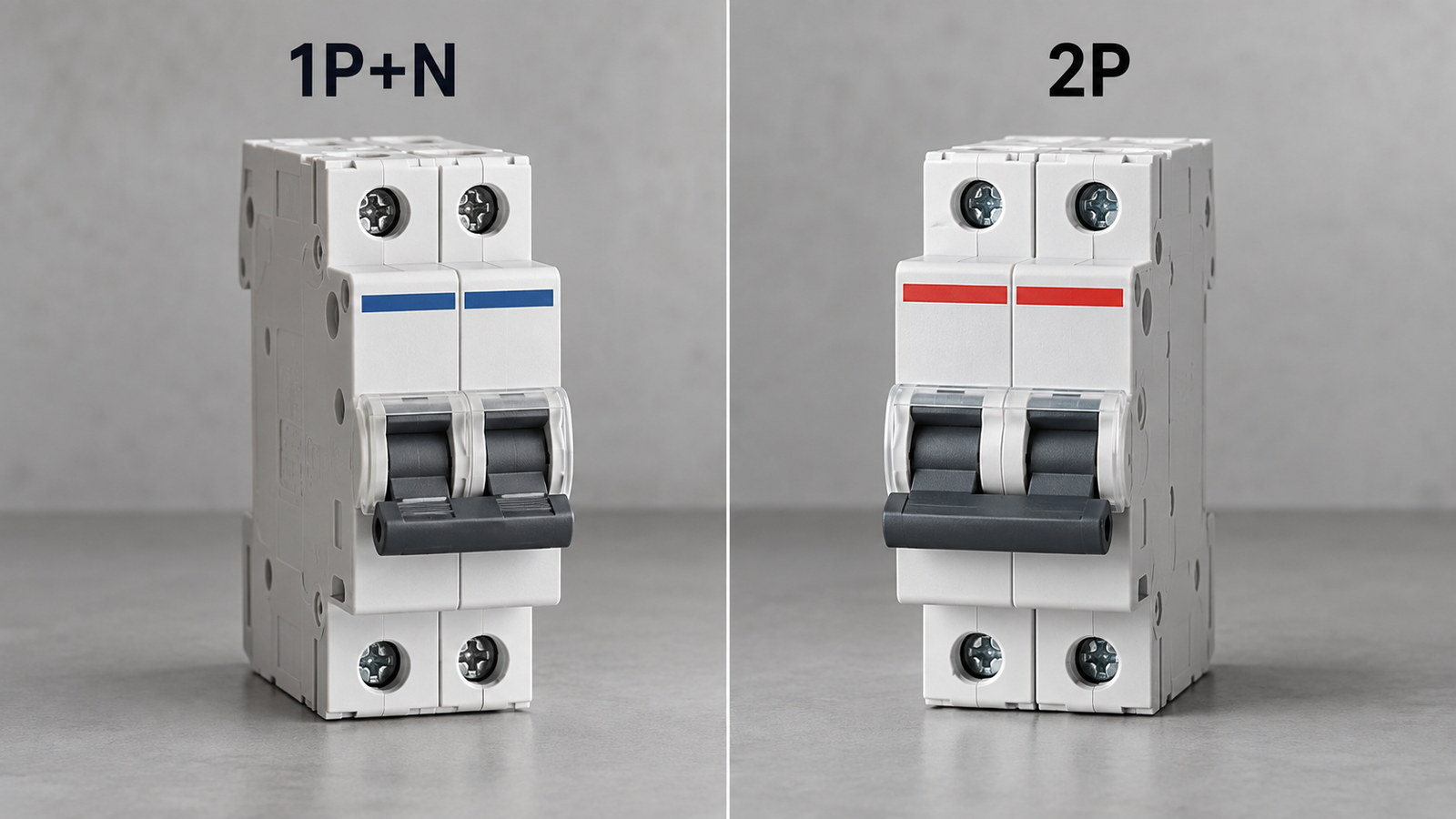
What Does 1P+N Mean?
At the most conservative level, 1P+N tells you that the breaker is configured around one phase pole plus a neutral pole. What happens inside those two poles depends on the product design.
A manufacturer may document which pole contains overcurrent protection, whether the neutral pole is switched, whether the neutral pole itself is protected, how the poles operate together, and the required connection arrangement. None of those details should be inferred automatically when the product page only says 1P+N.
Manufacturer-Specific Examples
ABB documentation for specific S200-series configurations identifies 1P+N as one protected pole with a switched neutral pole. This is a manufacturer-specific example and does not prove that a RITOKS 1P+N model has the same internal architecture.
Schneider Electric documentation for its N40 Phase + Neutral breaker describes phase-pole protection while both phase and neutral are switched. Again, this applies to that documented Schneider product, not to an undocumented model from another manufacturer.
What Does 2P Mean?
A 2P designation tells you that the product is offered as a two-pole circuit breaker configuration. That alone does not establish what each pole does in every product family.
Some manufacturer-specific 2P MCBs explicitly identify both poles as protected. For example, Hager documents its MB206A as having two protected poles and two total poles. Eaton publishes similar product-specific data for particular 2P MCBs. These examples demonstrate why exact documentation matters; they do not establish a universal definition for every 2P breaker.
Configuration Labels Do Not Define Every Internal Detail
1P+N Is Not a Universal Internal-Architecture Shortcut
A buyer may see a documented 1P+N design from a major manufacturer and assume the same arrangement applies universally. That is risky. The catalog label identifies the general configuration; model-specific technical documentation should confirm the protected-pole arrangement, neutral behavior, switching behavior, wiring arrangement, device width and relevant operating details.
2P Does Not Automatically Define the Conductors
“2P always means phase plus neutral” is too broad. A two-pole breaker describes a two-pole device configuration. The actual conductor arrangement depends on the system, product documentation and project design. The label alone should not determine mandatory phase/neutral assignment, two-line operation, required neutral treatment, isolation requirements or local wiring compliance.
Neutral Switching and Neutral Protection Are Separate Questions
A pole can be involved in switching without necessarily being described as the protected pole in a particular product design. The Schneider N40 example illustrates this distinction. Better buyer questions include whether the neutral is switched, whether it is protected, whether the poles are mechanically linked, whether switching is simultaneous, whether a wiring diagram is published, and whether a particular connection orientation is required.
For current RITOKS products discussed below, those internal details are not yet published, so they should be confirmed separately when required.
Module Width Must Also Be Verified
Pole designation does not always tell you the exact physical width of a breaker. Different manufacturers and product families may package phase-and-neutral functions differently. Compact manufacturer examples do not mean every 1P+N breaker occupies the same number of DIN-rail modules.
- Total device width
- Number of DIN modules
- Terminal layout
- Adjacent-device clearance
- Busbar compatibility
For current RITOKS products, use only dimensions or mounting details explicitly published for the exact model. Do not treat a wiring-height dimension as module width.
Current RITOKS 1P+N and 2P Options
The current AC Power Protection range and Miniature Circuit Breakers (MCB) category confirm configuration availability. They do not document internal neutral or pole behavior for the reviewed models.
| RITOKS Model | Published Configuration Availability | Internal Pole / Neutral Behavior |
|---|---|---|
| RTSXD01 | 1P+N, 2P, 3P, 3P+N, 4P | Not documented |
| RTSXD03 | 1P+N | Not documented |
| RTSXD02 | 1P+N | Not documented |
| RTSXD04 | 1P+N, 2P, 3P, 3P+N, 4P | Not documented |
| RTS-ACM60 | 1P, 2P | 1P+N not published; 2P internal behavior not documented |
| RTS-AC47 | 1P, 2P, 3P, 4P | 1P+N not published; 2P internal behavior not documented |
This table is intentionally conservative: it confirms which configurations are published without claiming how a neutral pole is protected or switched.
Models Offering Both 1P+N and 2P
RTSXD01 publishes 1P+N, 2P, 3P, 3P+N and 4P options. Its page also publishes AC 230/400V, 1–63A and B/C/D curve availability. It does not publish enough information to define the internal neutral behavior of its 1P+N version or the protection arrangement of its 2P version.
RTSXD04 publishes the same configuration set. Configuration availability is confirmed, but detailed pole-by-pole internal behavior is not.
Reviewed Models Published as 1P+N
RTSXD02 and RTSXD03 are each published as AC 240V, 1–32A, 1P+N models with 6kA breaking capacity and B/C curve availability. Their configuration label is confirmed; neutral switching and protection details are not documented on the current product pages.
Models Offering 2P Without Published 1P+N
RTS-ACM60 publishes 1P and 2P configurations, while RTS-AC47 publishes 1P, 2P, 3P and 4P. Neither page currently publishes a 1P+N option. Their 2P internal protection or neutral arrangement should not be inferred from the label alone.
Pole Configuration Is a Separate Selection Parameter
Pole Configuration Is Different From Trip Curve
A product might be described as 1P+N, C curve or 2P, C curve. Here, 1P+N or 2P describes the configuration, while C describes the trip characteristic. One does not determine the other. See B Curve vs C Curve vs D Curve MCBs: What’s the Difference? for the separate trip-characteristic question.
Pole Configuration Is Different From Breaking Capacity
Likewise, 1P+N or 2P does not tell you whether the breaker is rated 6kA, 10kA or another short-circuit capacity. Breaking capacity is a separate electrical parameter. See 6kA vs 10kA MCB: Understanding Breaking-Capacity Ratings for that separate question.
For the broader relationship among current, poles, trip curve, breaking capacity and mounting, use the AC MCB Selection Guide.
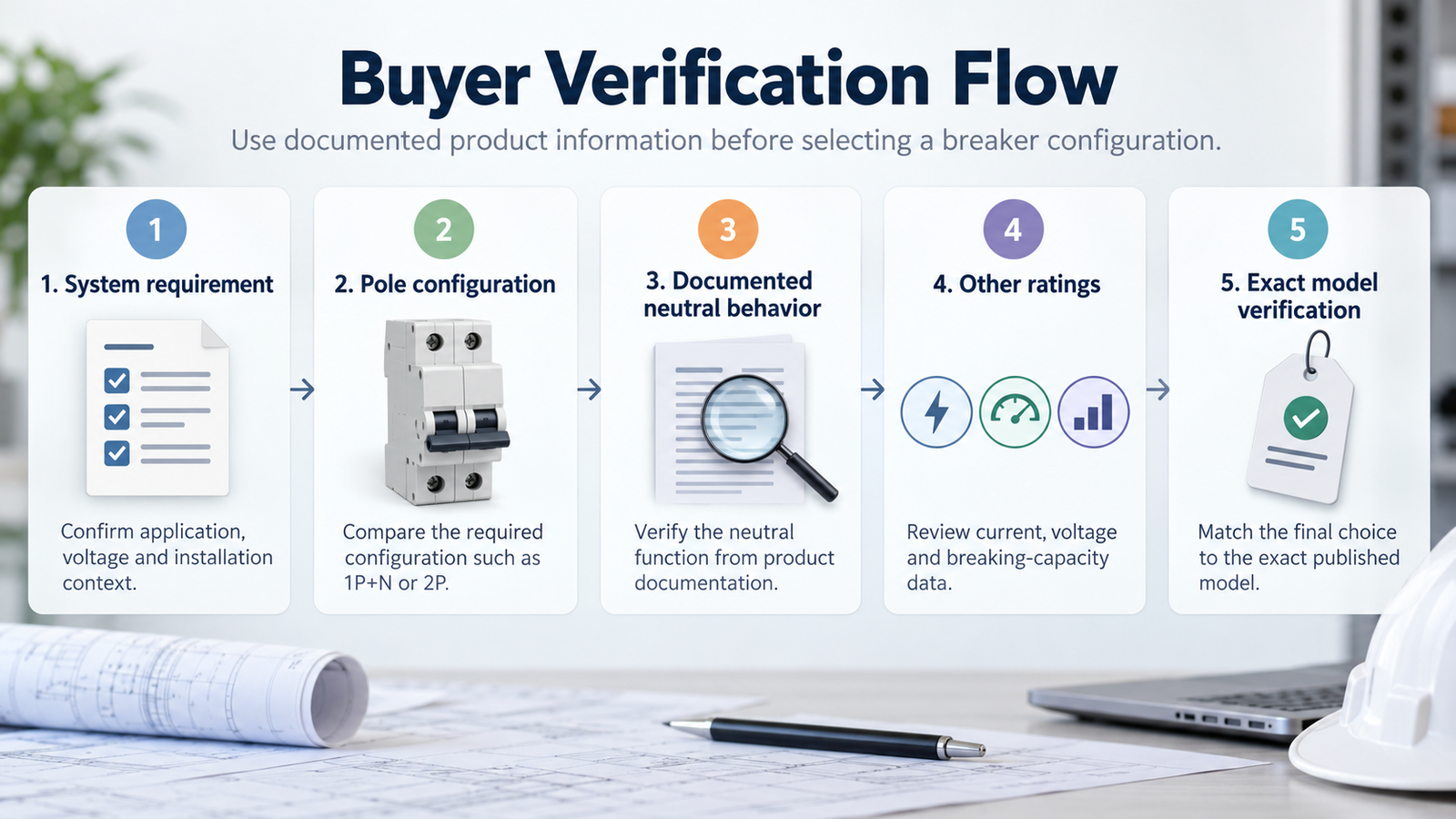
Questions Buyers Should Ask Before Choosing 1P+N or 2P
1. What Pole Configuration Is Specified?
If the project documentation already says 1P, 1P+N or 2P, use that as the starting point. Do not substitute another configuration merely because the rated current is the same.
2. What Does the Manufacturer Document About the Neutral?
Ask whether exact model documentation confirms neutral switching, neutral protection, conductor assignment and operating mechanism. Do not infer these details from the catalog title.
3. What Voltage and Current Ratings Are Required?
Pole configuration does not establish voltage or current. A 1P+N 16A, 1P+N 32A, 2P 16A and 2P 32A configuration are different sourcing combinations.
4. What Trip Curve and Breaking Capacity Are Required?
Confirm the specified trip characteristic and breaking capacity independently from the pole configuration.
5. Is Exact Technical Documentation Required?
For OEM panels and technical procurement, consider requesting a datasheet, dimensional drawing, connection diagram, protected-pole information, switching description, applicable standard information and exact model code.
Applicable local electrical rules and project requirements should be verified separately.
Common 1P+N vs 2P Buying Mistakes
Assuming Every 1P+N Breaker Has the Same Internal Architecture
Manufacturer examples may look similar, but exact model documentation should be checked.
Assuming Every 2P Breaker Means Phase + Neutral
A two-pole designation does not itself define the required conductor assignment for every electrical system.
Treating Pole Count as a Safety Ranking
2P is not automatically “safer,” and pole count is not a universal quality ranking. The correct configuration depends on the electrical design and applicable requirements.
Assuming 1P+N Is Always Smaller
Some product families use compact designs, but module width must be verified from exact dimensional information.
Guessing Neutral Behavior From an Image
A photo may show terminal count and physical form, but internal electrical behavior should come from technical documentation, not an AI image or product photo.
What Should Be Included in an MCB RFQ?
Use an AC MCB RFQ checklist for a clearer inquiry and provide:
- System voltage
- Current rating
- Required pole configuration
- Required trip curve
- Required breaking capacity
- Quantity and application
- Required mounting format
- Required product documentation
If neutral behavior is important to the project, explicitly ask the supplier to confirm whether the neutral is switched, whether it is protected, any relevant switching arrangement, the exact connection diagram and the exact model documentation. Do not leave these points to assumption.
Frequently Asked Questions
What is the main difference between 1P+N and 2P circuit breakers?
They are different pole or configuration designations. The exact difference in protected poles, neutral switching and internal behavior must be confirmed from the specific product documentation.
Does 1P+N always mean one protected phase and one switched neutral?
Not as a universal assumption. ABB and Schneider publish specific 1P+N products with this type of documented arrangement, but another manufacturer’s breaker should be confirmed separately.
Does 2P always mean both poles are protected?
Some specific 2P MCBs from Hager and Eaton explicitly document two protected poles, but that information should not be generalized to every 2P product without model-specific evidence.
Is 2P better than 1P+N?
Not inherently. They are different configurations. The correct choice depends on project requirements and the documented behavior of the exact breaker.
Is 1P+N always one DIN module wide?
No universal conclusion should be made from the configuration name alone. Product width should be checked from the manufacturer’s dimensional information.
Does RITOKS offer both 1P+N and 2P MCBs?
Yes, on selected families. RTSXD01 and RTSXD04 publish both 1P+N and 2P options. RTSXD02 and RTSXD03 publish 1P+N, while RTS-ACM60 and RTS-AC47 publish 2P among their available configurations.
Can I determine neutral switching from the current RITOKS product pages?
Not for the reviewed models. Current product pages confirm configuration availability but do not publish enough model-specific information to define neutral switching or protection behavior.
Need Help Confirming an MCB Configuration?
When sourcing an AC miniature circuit breaker, the configuration label is only one part of the specification. RITOKS publishes MCB families with different pole configurations, current ratings, B/C/D curve options, breaking-capacity ratings and mounting formats.
For projects where neutral switching, protected-pole arrangement or exact internal behavior matters, include those requirements directly in the RFQ so the exact model can be verified before selection.
Related Resources
Continue exploring AC Power Protection

AC MCB RFQ Checklist: What Buyers Should Specify
AC MCB RFQ Checklist: What Buyers Should Specify A clear AC miniature circuit breaker RFQ can save multiple…
Read guide
6kA vs 10kA MCB: Understanding Breaking-Capacity Ratings
6kA vs 10kA MCB: Understanding Breaking-Capacity Ratings Representative AC MCB formats shown in an industrial electrical workbench environment.…
Read guide