
Technical Resources · Selection Guide
Type 2 AC Surge Protective Device Selection Guide
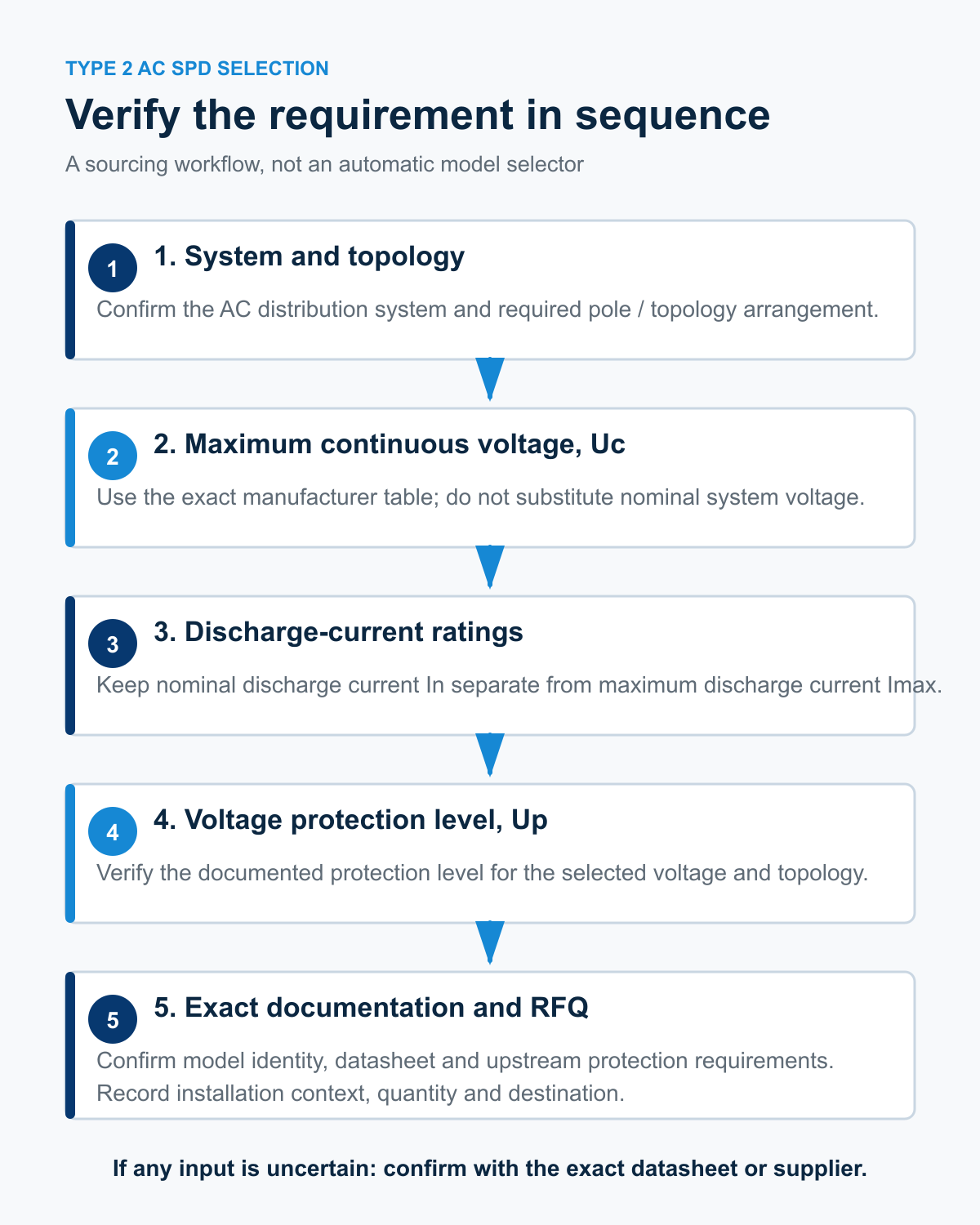
Selecting a Type 2 AC surge protective device requires more than matching one discharge-current value. The AC system, connection topology, maximum continuous operating voltage, discharge-current ratings, voltage protection level, upstream protection requirements and exact manufacturer documentation must remain connected to one verified model or family record.
This guide organizes those inputs for sourcing and RFQ preparation. It does not replace an electrical design, risk assessment, installation instruction or manufacturer coordination table.
Type 2 AC SPD Selection at a Glance
Official manufacturer guidance treats SPD type, system arrangement, Uc, In, Imax and Up as separate selection characteristics. The Schneider Electric SPD selection guidance and its electrical-installation documentation support this general framework. Their product ratings are not RITOKS product data.
| Selection field | What to verify |
|---|---|
| SPD classification | Use explicit Type 2 wording from the exact manufacturer record. Do not infer another class label. |
| AC system and topology | Define the distribution arrangement and the required pole or protection-path topology. |
| Uc | Confirm the maximum continuous operating voltage option in the exact product table. |
| In | Keep the nominal discharge current and its waveform attached to the exact model record. |
| Imax | Keep the maximum discharge current separate from In. |
| Up | Confirm the voltage protection level for the selected Uc, mode and topology where applicable. |
| Upstream protection | Use only an exact manufacturer table or installation document for breaker or fuse requirements. |
| Documentation | Request the exact datasheet, topology information, installation instructions and required certificates. |
1. Confirm the Type 2 Scope and AC Application
Use the classification stated by the exact manufacturer source. Type 2 must not be expanded into an unsupported Class II, Type 1+2 or other label. General technical references describe Type 2 devices in distribution and equipment-protection contexts, but the correct location and protection architecture still depend on the installation and applicable rules.
Keep AC and DC SPDs separate. A DC PV SPD has different system, polarity and voltage considerations and cannot supply missing data for an AC product.
2. Define the AC System and Connection Topology
State whether the project is single-phase or three-phase and identify the required conductor and protection-path arrangement. A pole count or family photograph is not enough to define topology. Use the exact manufacturer diagram or topology label, then have the final installation reviewed against the applicable system documentation.
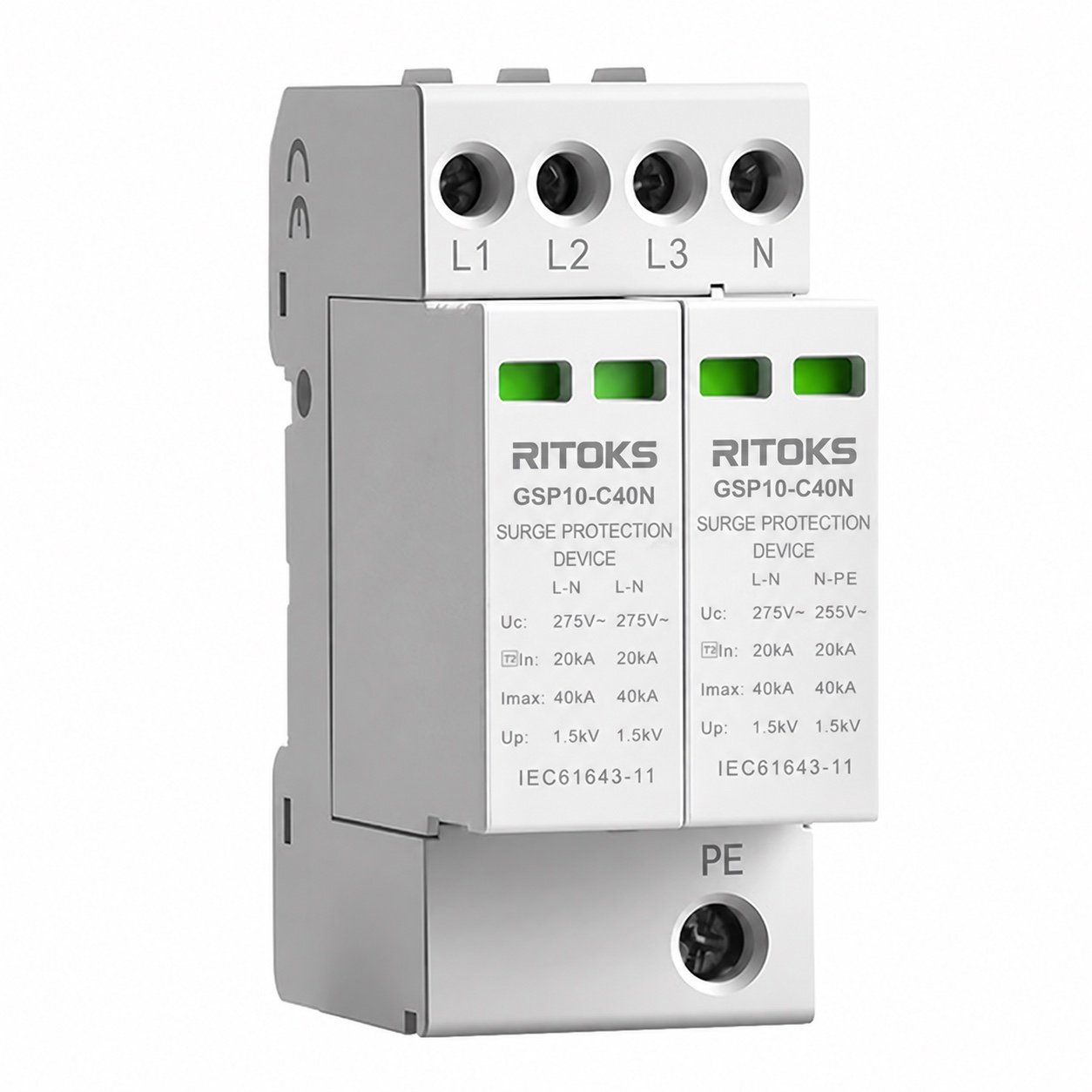
The published GSP10-C40N Type 2 AC SPD documents four family configuration labels: 2P, 1+NPE, 4P and 3+NPE. These labels support configuration screening; they are not installation instructions.
3. Select and Verify Maximum Continuous Operating Voltage, Uc
Uc is the maximum voltage that can be applied continuously to the SPD under the documented conditions. It must not be treated as a nominal system-voltage label. Record the actual system and mode of connection, then select the Uc option from the exact manufacturer table.
GSP10-C40N publishes 275V, 320V and 385V AC Uc options. The article does not map those options automatically to a project voltage; the buyer must confirm the correct option for the exact system.
4. Keep In and Imax Separate
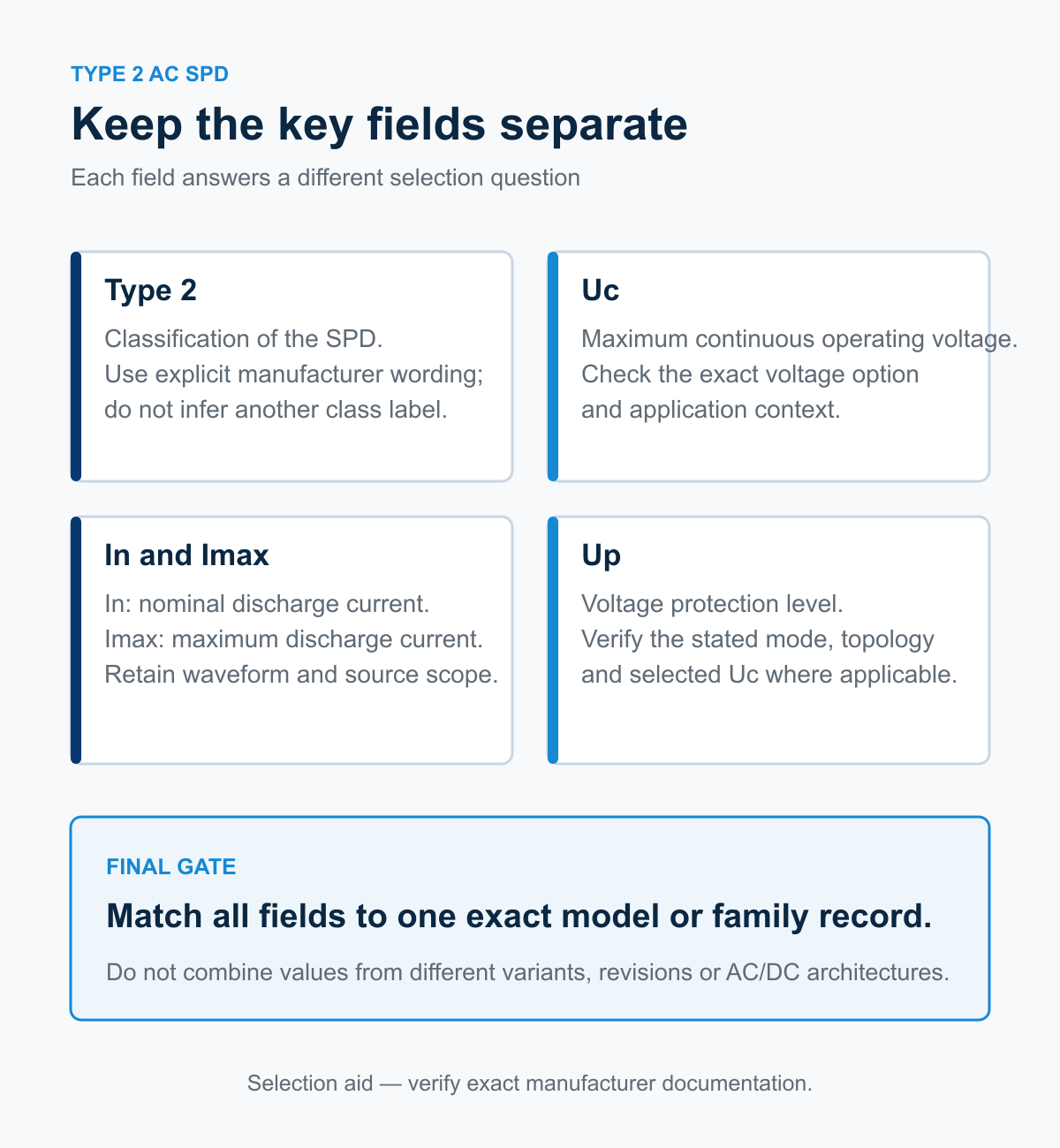
In is the nominal discharge-current rating and Imax is the maximum discharge-current rating. They answer different questions and must remain attached to their stated waveform and source. A larger-looking number cannot substitute for the other field.
For GSP10-C40N, the verified product record lists In 20kA and Imax 40kA, both with an 8/20 microsecond waveform. Those values apply to this exact family record and must not be copied to another GEYA suffix or an unrelated SPD.
5. Verify Voltage Protection Level, Up
Up describes the voltage protection level under the documented test condition. Verify the value for the selected Uc and protection path rather than publishing one family-wide number without context.
The GSP10-C40N record lists L-N Up of 1.5kV for the 275V and 320V Uc options and 1.8kV for the 385V option. A separate N-PE value is documented where that protection path applies. These values remain model- and topology-scoped.
6. Treat Upstream Protection as a Separate Evidence Gate
An SPD may require a coordinated upstream fuse or circuit breaker, but the device type and rating cannot be inferred from Imax, a product photograph or a neighboring catalog. Use the exact manufacturer installation document and the prospective short-circuit conditions at the installation point.
The related GYCM8 molded case circuit breaker is an adjacent protection family, not a documented GSP10-C40N backup-protection pairing.
Published RITOKS Type 2 AC SPD Example
| Published field | GSP10-C40N evidence | Selection use |
|---|---|---|
| Classification | Type 2 | Use the explicit wording only. |
| Uc | 275 / 320 / 385V AC | Confirm the exact option for the system. |
| In | 20kA, 8/20 microseconds | Keep separate from Imax. |
| Imax | 40kA, 8/20 microseconds | Do not treat as repetitive operating current. |
| Up (L-N) | 1.5 / 1.5 / 1.8kV by Uc option | Keep the mapping intact. |
| Topologies | 2P / 1+NPE / 4P / 3+NPE | Screen configurations; request exact documentation. |
| Mounting | 35mm DIN rail | Confirm enclosure and installation requirements separately. |
Browse the AC Surge Protective Devices category for the currently published family.
Information to Include in an AC SPD RFQ
- AC system and phase arrangement
- Required connection topology
- System voltage and proposed Uc option
- Required Type 2 classification evidence
- Required In, Imax and waveform documentation
- Required Up and protection mode
- Prospective short-circuit and upstream protection information for review
- Installation location, enclosure and mounting context
- Required datasheet, drawings, certificates and installation documents
- Quantity and destination
Technical References
- GEYA — GSP10-C40N Type 2 Surge Protection Device — Supports the exact GSP10-C40N identity, Type 2 classification and published product fields used in this guide.
- Schneider Electric — Surge Protection Device Selection Guidance — Supports treating Type, Uc, In, Imax and Up as separate selection characteristics.
Frequently Asked Questions
Is Uc the same as nominal system voltage?
No. Uc is the maximum continuous operating voltage of the SPD under its documented conditions. The project system voltage and connection mode must be evaluated separately.
Are In and Imax interchangeable?
No. In is the nominal discharge-current rating and Imax is the maximum discharge-current rating. Keep each value tied to its waveform and exact manufacturer record.
Does a Type 2 SPD require an Iimp value?
This guide does not require or publish Iimp for the verified Type 2 GSP10-C40N record. Missing Iimp is not treated as zero.
Can I use a DC PV SPD in an AC distribution panel?
Do not treat AC and DC PV SPDs as interchangeable. Use a device and documentation intended for the exact system architecture.
Can RITOKS specify the backup breaker from the SPD rating alone?
No. Upstream protection requires exact manufacturer coordination or installation documentation plus project short-circuit information.
For broader DC-only context, see DC Protection Devices Explained. It does not replace this AC SPD selection process.
Confirm a Type 2 AC SPD Requirement
Send RITOKS the AC system, topology, Uc, discharge-current requirements, Up requirement, installation context, documentation needs and quantity for exact-family review.