
Technical Resources · Selection Guide
DC Surge Protective Device Selection Guide: UCPV, In, Imax and Up
A DC surge protective device cannot be specified by a single kA number. A PV or other DC system has a voltage envelope, earthing and topology context, an intended installation location and an exact SPD configuration. The buying problem is to collect these inputs so a supplier can identify an orderable device and the documents that support its use. An AC SPD with a similar front label is not proof of DC suitability.
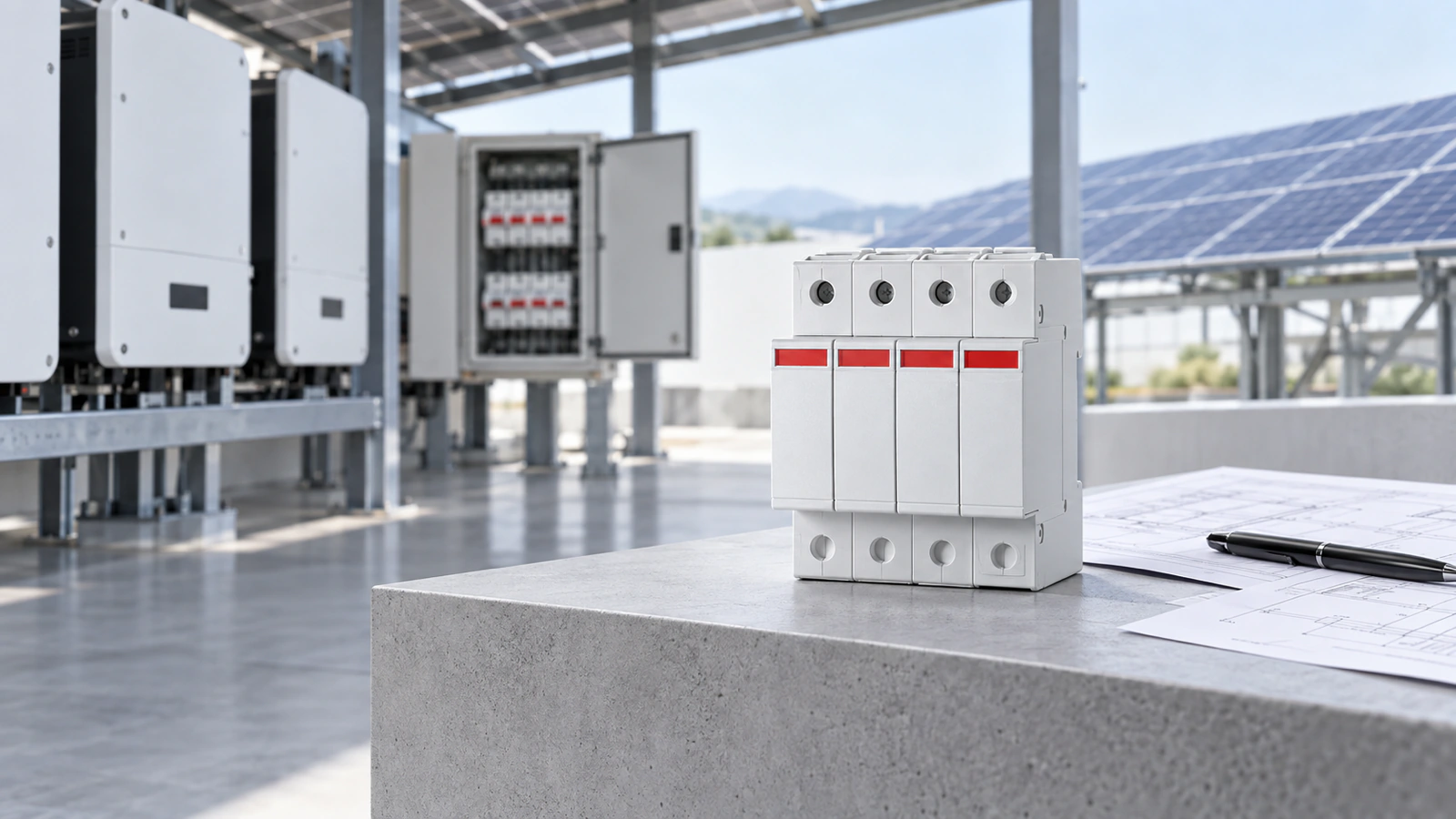
This article concerns DC-side selection evidence, especially for PV projects. It does not replace a surge-risk assessment, lightning-protection design or manufacturer installation instructions. Type, UCPV/Uc, In, Imax and Up must be compared as separately defined characteristics under the same exact model record.
Selection Factors at a Glance
| Input | What the buyer records | What the manufacturer must show |
|---|---|---|
| System | PV/DC source, maximum voltage, grounding and equipment context | The candidate’s intended DC application |
| Location | Proposed position in the system and external lightning-protection context | Appropriate SPD type and configuration for the stated design |
| Continuous voltage | Maximum voltage at the proposed SPD location | UCPV or Uc designation and limit for the exact model |
| Discharge data | Project surge-protection requirement | In and Imax, with definitions and test conditions |
| Protection level | Equipment and system requirements | Up for the exact configuration |
| Connection | Topology and any protective-device arrangement to be reviewed | Exact wiring and upstream protection instructions |
Define the DC-Side Application Before Reading the SPD Label
Record whether the project is a PV array, combiner, inverter DC input or another specified DC system. Provide the maximum voltage relevant to the proposed SPD position, not only the nominal system description. Ask the designer for the earthing arrangement and intended protection location. These inputs influence the applicable SPD configuration; the article does not infer one from a photograph or a pole count.
Phoenix Contact’s PV surge-protection guidance discusses different installation contexts and separates AC- and DC-side locations. Its examples belong to Phoenix Contact’s own system recommendations. Use them to understand which project questions to ask, not as a wiring drawing or a universal product prescription for RITOKS. If the project’s lightning-protection and exposure information is unavailable, identify it as an open design input.
What UCPV, In, Imax and Up Answer
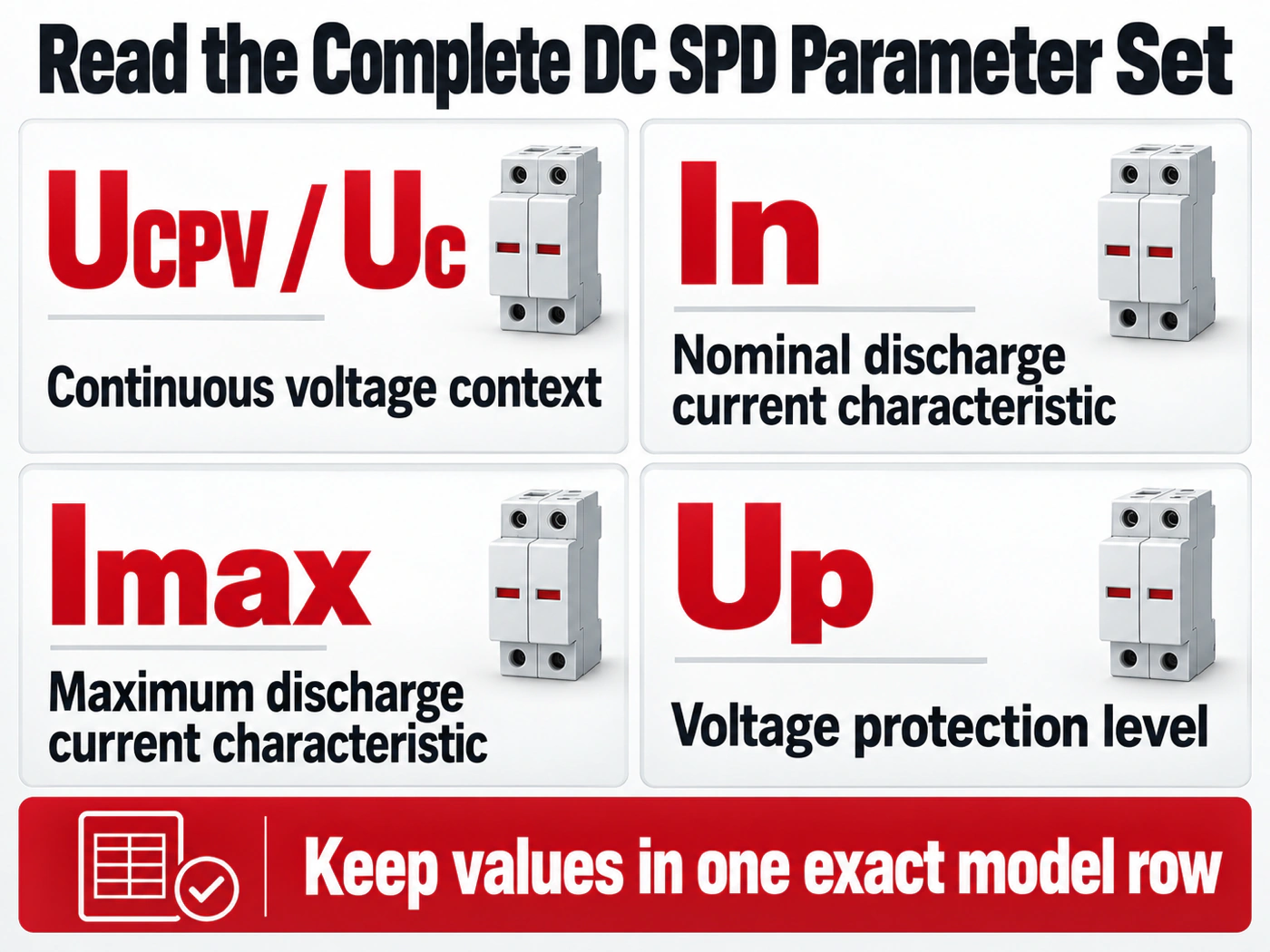
UCPV is a PV-oriented designation for maximum continuous voltage; some DC product records use Uc. Read the exact device’s symbol and test context rather than assuming the labels are interchangeable across every technology. Compare the documented continuous-voltage limit with the project’s maximum possible voltage. A value selected only from nominal operating voltage could miss a higher condition elsewhere in the system.
In and Imax are different discharge-current characteristics. They do not replace each other or directly state the protective voltage seen by equipment. Up is a protection-level characteristic to be read from the exact configuration and relevant test conditions. A larger headline Imax number is not automatically the better answer to a project’s protection-level requirement. If a brochure quotes values for several variants in one table, keep all fields in the same row.
Read Topology and Backup Requirements From One Exact Device
A “2P” or “3P” description does not tell the reader how to connect a PV SPD. Ask for the specific circuit diagram, grounding context and manufacturer instructions for the quoted orderable variant. Also ask whether the manufacturer requires, limits or specifies an upstream protective device. Do not select a fuse or breaker from a nominal SPD discharge rating; any proposed combination needs its own documented basis.
Record any status indication or replaceable-module requirement as an ordering preference, then verify that the selected code actually includes it. A family image may show options not present in the chosen version. These details matter to maintenance and purchasing, but they do not change the core voltage and surge evidence requirements.
Compare Offers by Complete Parameter Sets
| Question | Comparable evidence | Insufficient evidence |
|---|---|---|
| DC application | Exact DC/PV designation and orderable code | AC-only page or unrelated family image |
| Voltage | UCPV/Uc for selected model and system maximum | Nominal voltage alone |
| Surge figures | In, Imax and Up together with their test context | Single kA headline |
| Topology | Exact wiring diagram and backup instructions | Pole count without diagram |
A buyer should compare the offers against the same project record, not rank isolated headline values. If one candidate lacks a parameter or its diagram is for a neighboring model, request the correct document. The absence of a stated backup requirement in a sales listing does not prove that no upstream protection is needed.
Keep the SPD type and the four electrical parameters in a single comparison record. Do not mix the lowest Up from one configuration with the UCPV or discharge-current values of another. Note whether a value belongs to a complete device or a replaceable module, and record the document revision. This prevents a procurement spreadsheet from creating a configuration that the manufacturer never offered.
Buyer Workflow and RFQ Preparation
- Record source type, maximum voltage, intended SPD location, earthing and lightning-protection context.
- Ask the responsible designer which protection function and type are required for that location.
- Obtain exact order codes and model-specific UCPV/Uc, In, Imax and Up data with test context.
- Request the exact connection diagram, upstream protective-device instructions and any replaceable-module details.
- Compare only complete configuration rows; send unresolved system or document questions back for engineering review.
- Include quantity, destination and required documentation with the RFQ, without declaring an unverified pairing.
Published RITOKS DC SPD Examples
RITOKS publishes separate RTS-SPD40-PV and LT1 DC PV SPD families. Their pages are product examples, not one merged specification table. A value associated with an LT1 configuration must not be assigned to RTS-SPD40-PV, nor may an AC SPD’s Type 2 classification or rating be borrowed for either DC family. Refer to the exact product row and request the corresponding manufacturer evidence.
For a replacement inquiry, include photographs only as identification support and still provide the existing order code and datasheet where available. For a new project, include the designer’s stated SPD type and location rather than asking the supplier to infer the complete protection concept from the inverter rating. In both cases, keep installation approval outside the sales comparison until the exact documents have been reviewed.
Record Location, Replacement and Maintenance Inputs
The same project can contain more than one surge-protection location, and each location may have a different electrical and exposure context. Give every proposed SPD position a clear identifier in the RFQ. Attach the designer-provided system information for that position rather than describing the entire installation with one voltage label. This prevents a device intended for one location from being compared with a candidate documented for another role.
For replacement work, record the complete device and replaceable-module codes, the original connection document and any upstream protective-device requirement. A plug-in module that fits the base is not automatically the correct replacement. Ask whether status indication, remote signaling or module coding is part of the exact configuration. These maintenance features belong in the ordering record but must not be used to infer the core surge or voltage characteristics.
Stop Conditions and Approval Record
Do not close the comparison when the system maximum voltage, earthing context, required SPD type or proposed location remains undefined. Also stop when UCPV or Uc, In, Imax and Up come from different variants, or when the only connection evidence is a generic family image. These gaps are not solved by selecting the largest discharge-current number. They require the project designer and manufacturer to establish one coherent configuration.
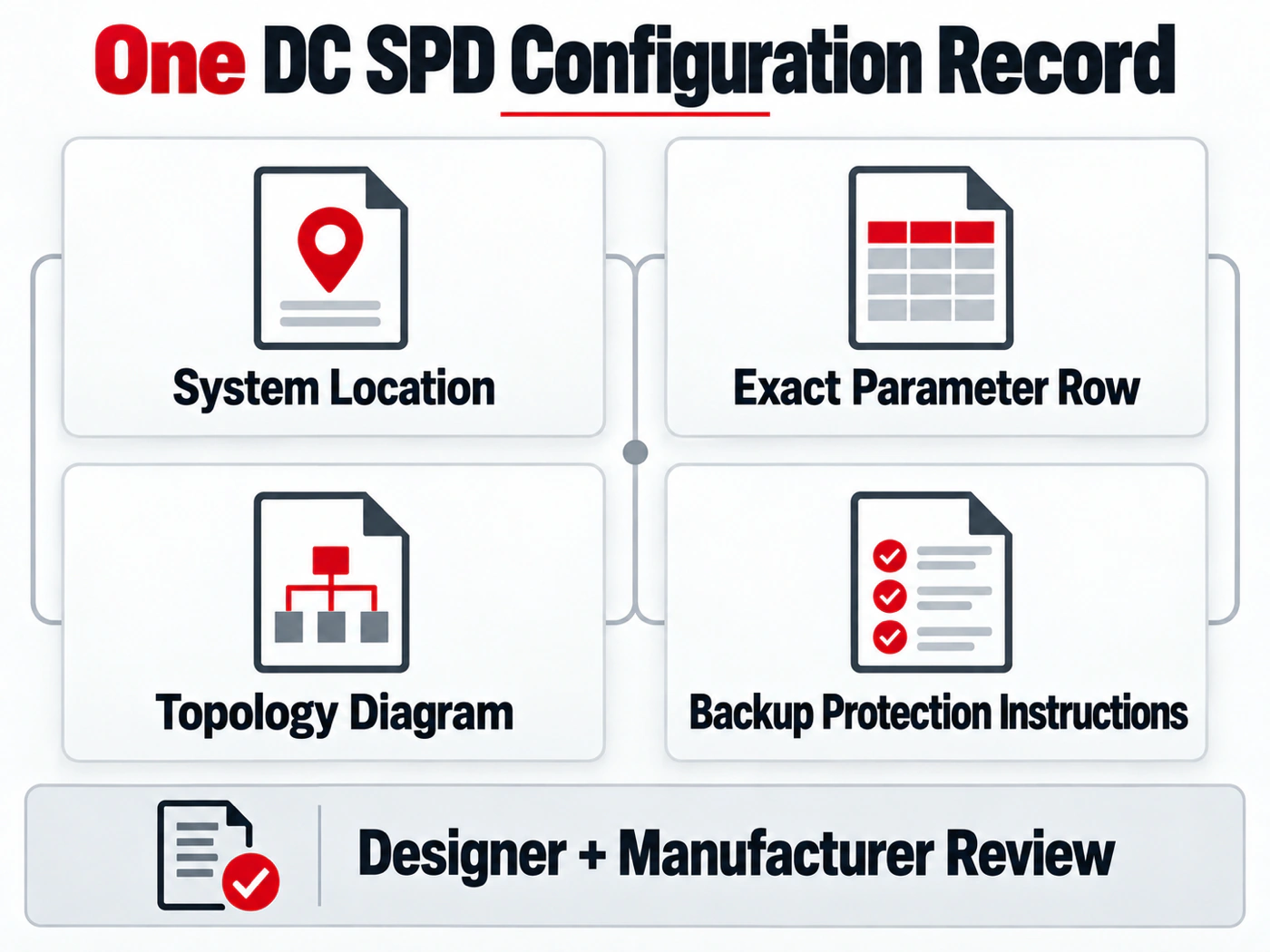
The approval record should preserve the system input, exact device code, parameter row, topology drawing, backup-protection instructions and document revisions together. The supplier can confirm availability and documentation; the buyer can compare complete offers; the responsible designer confirms the protection concept and installation. An RFQ that maintains these boundaries is useful even when several engineering inputs are still open, because the missing evidence remains visible instead of being converted into assumptions.
For maintenance planning, ask how the exact device communicates end-of-life status and whether a replacement module has a separate order code. Record those items only when documented for the selected configuration. They can affect spare-parts purchasing and inspection routines, but they do not replace the project-level surge-risk assessment or justify transferring electrical parameters from another module.
Frequently Asked Questions
Is Imax enough to choose between two DC SPDs?
No. Check continuous voltage, the separate In and Up values, SPD type, topology and installation context from the exact records. A headline current cannot answer all of those questions.
Can an AC SPD be used if the kA number matches?
A matching kA number does not establish DC or PV suitability. Request a product expressly documented for the proposed DC application and configuration.
Does a pole count specify the wiring?
No. It is an incomplete description. Use the exact manufacturer diagram and qualified project review for the proposed system.
Related RITOKS Products and Guidance
Use these pages as separate product and family records. A link is not a claim that two devices are interchangeable or coordinated.
DC Surge Protective Devices category
Technical References
The following manufacturer sources support the general concepts identified below. Their model ratings, diagrams and approvals do not transfer to RITOKS products.
Phoenix Contact, Surge protection for photovoltaic systems
Supports the general distinction between PV DC-side locations and system context. Its example layouts and model data are Phoenix Contact-specific, not RITOKS instructions or ratings.
Request an Exact-Model Review
Send the recorded application requirements, exact documentation questions, quantity and destination through the RITOKS contact form. An RFQ requests an exact-model review; this guide does not approve a wiring design or recommend an automatic substitute.