
Rack Power Distribution · RFQ Checklist
Rack PDU RFQ Checklist: What Buyers Should Specify
A useful rack PDU RFQ should do more than say:

“Please quote a rack PDU.”
Rack power distribution units can differ in voltage, current, input connection, output sockets, outlet count, rack format, cable arrangement and optional requirements.
If those details are missing, the supplier may need several rounds of clarification before an exact product or variant can be compared.
A better approach is to provide the requirements already defined by the project.
That does not mean the supplier should automatically calculate the electrical design from a server count or a general rack description.
The purpose of an RFQ is simpler:
Buyer-defined requirements → product and variant matching → documentation confirmation → quotation
For broader guidance on comparing PDU configurations, see the Rack PDU Selection Guide.
Contents
Rack PDU RFQ Quick Checklist
| Parameter | What the Buyer Should Provide | Why It Matters |
|---|---|---|
| Input voltage | Required voltage | PDU families may use different electrical ratings |
| Rated current | Required current | Helps narrow suitable product configurations |
| Input plug / connector | Required upstream connection | Input connection is separate from output socket type |
| Output sockets | Required receptacle format | Must match the equipment connection requirement |
| Outlet count | Required number of outputs | Available counts vary by product family |
| Rack format | 1U, 0U or other project requirement | Physical availability must be confirmed by model |
| Cord requirement | Length, corded or no-cord requirement | Cable arrangements vary by configuration |
| Required features | Switch, surge, metering, monitoring, etc., if needed | Current availability must be confirmed |
| Quantity | Required quantity | Needed for commercial quotation |
| Documentation | Required drawings, specifications or evidence | Availability depends on exact product and variant |
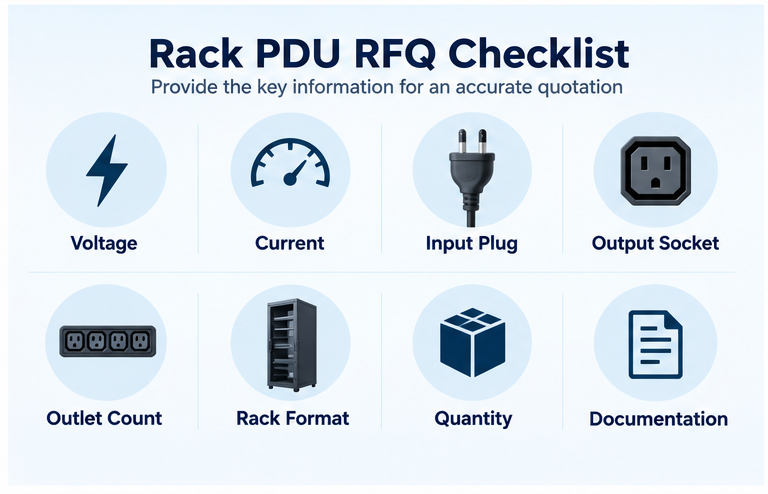
Not every project needs every field.
But where a requirement is already known, putting it in the initial RFQ reduces ambiguity.
1. Specify the Required Input Voltage
Start with the voltage required by the project.
Current published RITOKS rack-power products include different voltage configurations.
For example:
RTS-PDU-US8-15A — AC125V
RTS-PDU1U-10A — AC250V
These are model-specific published values.
They are not universal voltage recommendations.
A useful RFQ field is:
Required input voltage: [voltage]
If the voltage requirement has not yet been defined by the project engineering team, do not guess it simply to complete the inquiry.
2. Provide the Required Current
Rated current should be stated separately from voltage.
Current published examples include:
RTS-PDU-US8-15A — 15A
RTS-PDU1U-10A — 10A
RTS-PDUSM also includes designated modular components with 10A or 16A markings, but RTS-PDUSM is a component family, not an assembled PDU.
A component rating should therefore not be treated as proof of a complete rack PDU configuration with the same current.
For the RFQ:
Required current: [current]
The supplier should not be assumed to determine the required current merely from the number of connected servers.
3. Keep Input Plug and Output Socket Separate
This is one of the most important parts of a rack PDU inquiry.
Input Plug / Connector
This describes how the PDU connects to the upstream power source.
Output Socket / Receptacle
This describes what the connected equipment plugs into.
These are separate specifications.
A better RFQ uses two fields:
Input plug / connector: [required type]
Output sockets: [required type]
Do not write only:
Plug type: [type]
if it is unclear whether the buyer means the PDU input or the equipment-facing outputs.
4. Input Connector Requirements
RITOKS currently publishes the broadest input-component selection under RTS-PDUSM.
The component family lists options associated with:
China 10A / 16A
European
UK
US
Australian
Italian
IEC C13 / C14 / C19 / C20
16A / 32A industrial options
However, RTS-PDUSM is a modular component family.
These options do not prove that every connector can be combined with every assembled PDU configuration.
For Products 257 and 259, the exact input plug is not currently published.
Therefore, if input connection matters, put the required connector directly in the RFQ and ask for exact-variant confirmation.
5. Specify the Required Output Socket Format
Output socket requirements should also be written explicitly.
Current RITOKS evidence includes:
RTS-PDUSM
Modular outlet components include options such as:
universal
regional socket modules
C13
C19
C13 slide-lock
Again, these are modular components, not proof of a complete assembled C13 or C19 rack PDU.
RTS-PDU-US8-15A
Published assembled configuration:
eight grounded US-style three-slot outlets
The exact NEMA designation is not currently published.
RTS-PDU1U-10A
Published configuration:
three-slot outlets
The exact regional outlet standard is not currently confirmed.
A useful RFQ field is:
Required output socket / receptacle: [type]
6. State the Required Outlet Count
Outlet count is usually one of the easiest requirements for a buyer to specify.
Current published examples include:
RTS-PDU-US8-15A
8 outlets
RTS-PDU1U-10A
Published variants include:
2
3
4
5
6
7
8
10
12
14 outlets
For an inquiry:
Required outlet count: [number]
Do not assume that more outlets mean more electrical capacity.
Outlet count, current and voltage are separate specifications.
7. If You Need a Mixed Outlet Layout, State It Separately
Some projects may require more than one socket format in the same power-distribution assembly.
A buyer may include:
Required outlet mix: [requirement]
But this should be treated as a request requiring confirmation, not as a currently guaranteed RITOKS configuration.
RTS-PDUSM provides multiple modular socket component types, but current product evidence does not establish every possible assembled mixed-socket PDU combination.
8. Specify the Required Rack Format
If the project already defines the physical rack format, include it.
For example:
Rack format: [required format]
Current RITOKS evidence confirms:
RTS-PDU1U-10A
1U
Current evidence does not confirm:
a RITOKS 0U product
Product 257 as 1U
Product 257 as horizontal or vertical
Product 259 as vertical
A buyer may still request:
0U required
or:
Vertical mounting required
but that should be treated as a project requirement whose product availability needs confirmation.
Do not turn the buyer’s request into a claim that RITOKS already offers that format.
9. Include Available Rack Space or Dimensional Constraints
For OEM racks and cabinets, available physical space can matter.
Useful RFQ information may include:
maximum width
maximum depth
available rack units
mounting-clearance requirement
mounting-hardware requirement
A suitable field is:
Available space / dimensional constraint: [requirement]
Current rack-product pages do not publish all of the dimensional and mounting details needed for every variant, so exact drawings should be requested where mechanical fit is important.
10. Specify the Cord Requirement
Cable configuration should not be overlooked.
Current product evidence includes:
RTS-PDU-US8-15A
1.8m cable on the assembled configuration
RTS-PDU1U-10A
2m cord option
no-cord variant
A buyer can therefore include:
Cord requirement: [length / no-cord / other requirement]
If a different cord length, plug or cable arrangement is needed, list it as a requirement and ask for exact-variant confirmation.
Do not assume every requested customization is automatically available.
11. State Whether a Master Switch Is Required
Some projects may need a local master switch.
Current published data confirms:
RTS-PDU1U-10A
double-pole master switch
RTS-PDU-US8-15A is supplier-described as having a surge-protected switch, although detailed surge-performance data remains pending.
For an RFQ:
Master switch requirement: [yes / no / specified requirement]
A local master switch should not be confused with intelligent remote outlet switching.
Current RITOKS product pages do not confirm remote-switched PDU functionality.
12. Advanced Features Can Be Requested — But Availability Must Be Confirmed
A project may require features such as:
metering
remote outlet switching
network monitoring
SNMP
environmental monitoring
ATS functionality
These can be included in a buyer’s RFQ.
For example:
Metering required: [requirement]
Remote monitoring required: [requirement]
But current RITOKS rack PDU evidence does not confirm these product families or capabilities.
The safe wording is:
Include the requirement if your project needs it; availability must be confirmed for the exact product.
Do not assume that an advanced feature exists simply because it is common elsewhere in the rack PDU market.
13. Be Specific About Surge-Protection Requirements
Surge-related requirements also need careful wording.
Current evidence includes:
RTS-PDUSM
SPD module option
RTS-PDU-US8-15A
supplier-described surge-protected switch
However, exact surge ratings, test evidence and protection levels are not currently published.
A buyer can therefore specify:
Required surge protection: [project requirement]
and:
Required surge documentation: [document requirement]
Do not assume a joule rating, protection level or certification that has not been published.
14. Breaker or Fuse Requirements Should Be Listed as Buyer Requirements
Current product pages do not publish enough information to confirm breaker or fuse configurations across the reviewed Rack Power Distribution products.
If the project requires a particular protection arrangement, state it:
Breaker / fuse requirement: [requirement]
Availability then needs exact-product confirmation.
Do not treat the RFQ field itself as evidence that the supplier already offers the requested protection device.
Current Product Families and RFQ-Relevant Information
| Product | Useful Published Information | What Still Needs Confirmation |
|---|---|---|
| RTS-PDUSM | Modular input/socket components; regional, C13/C19 and other connector options; designated 10A/16A modules | Exact voltage, assembled configuration, outlet count, rack format, cord, dimensions and certifications |
| RTS-PDU-US8-15A | AC125V, 15A, 1875W, 8 US-style outlets, 1.8m cable | Exact input plug, NEMA type, rack format, dimensions, certification and detailed surge evidence |
| RTS-PDU1U-10A | AC250V, 10A, 2500W, 1U, 2–14 outlet variants, 2m/no-cord options, double-pole master switch | Exact input plug, regional outlet standard, dimensions, mounting hardware and certification |
This table is for RFQ preparation only.
It does not imply that missing fields can be inferred from the published ones.
15. Specify Quantity and Project Context
Commercial information matters too.
Include:
Quantity: [required quantity]
Project / rack context: [brief description]
The context may help distinguish, for example:
a single rack requirement
a panel or enclosure project
a prototype
a production batch
a repeated sourcing requirement
But project context should not be used as a substitute for electrical specifications.
16. Include the Destination Country or Region
Destination information can help clarify commercial and documentation requirements.
Use:
Destination: [country / region]
This can be relevant to:
required documentation
plug/socket requirements
labeling
packaging
shipping arrangements
However, destination information does not mean regulatory compliance is automatically guaranteed.
Any required market approval or certification should be stated explicitly.
17. Separate Standards, Certificates and Test Reports
If a project requires technical or compliance documentation, say exactly what is required.
Possible RFQ requests include:
datasheet
dimensional drawing
connection information
plug/socket specification
certification evidence
test report
surge documentation
product photos
packaging drawing
A standard reference is not automatically the same as:
a certificate
a test report
a market approval
Use wording such as:
Required standard: [standard]
Required certification/evidence: [document]
Required technical documents: [list]
Availability should then be confirmed for the exact product and variant.
18. Packaging, Labeling and OEM Requests
A buyer may also include commercial customization requirements, such as:
packaging
labeling
logo
private label
OEM branding
custom faceplate
custom plug
custom cord
socket arrangement
These are valid RFQ questions.
But current evidence does not support a universal claim that every RITOKS rack-power product supports every customization.
Use:
Packaging / labeling requirement: [requirement]
OEM / branding requirement: [requirement]
Custom configuration request: [requirement]
and ask for availability confirmation.
Example Rack PDU RFQ Template
Use the following template as a starting point.
Project Information
Company: [company]
Project / rack context: [description]
Destination: [country / region]
Quantity: [quantity]
Required delivery: [schedule]
Electrical and Connection Requirements
Input voltage: [required voltage]
Rated current: [required current]
Required power rating: [if specified]
Input plug / connector: [required type]
Output sockets: [required type]
Outlet count: [number]
Outlet mix: [if required]
Physical Requirements
Rack format: [1U / 0U / other requirement]
Orientation: [if specified]
Available space: [dimensions / constraint]
Cord requirement: [length / no-cord / other]
Mounting hardware: [if required]
Optional Features
Master switch: [requirement]
Surge protection: [requirement]
Breaker / fuse: [requirement]
Metering: [if required]
Remote switching: [if required]
Monitoring / SNMP: [if required]
Environmental monitoring: [if required]
Documentation and Commercial Requirements
Required standard: [if specified]
Certification evidence: [if required]
Technical documents: [list]
Packaging / labeling: [requirement]
OEM / private-label requirement: [if applicable]
Preferred model / family: [if known]
Additional Notes
Other requirements: [details]
This template communicates project requirements.
It does not replace electrical or rack-system engineering.
What If Some Requirements Are Not Yet Known?
An RFQ does not need invented answers.
If a parameter is still pending, write that clearly.
For example:
Input plug: To be confirmed
Rack format: Project requirement pending
Surge specification: To be defined
That is safer than selecting a specification without supporting project information.
The supplier can identify which details remain necessary for product matching.
Common Rack PDU RFQ Mistakes
Writing Only “8-Outlet PDU”
Outlet count alone does not identify voltage, current, input connector or socket format.
Using “Plug Type” Without Saying Input or Output
Input connector and output receptacle are different requirements.
Assuming C13/C19 Components Mean an Assembled PDU Exists
RTS-PDUSM is a component family.
Exact assembled configurations require confirmation.
Requesting “0U RITOKS PDU” as Though It Is Already Published
A buyer may request 0U, but current RITOKS availability is not confirmed.
Calling Any Switch a “Switched PDU”
A local master switch is not the same as remote outlet-level switching.
Asking for “Smart PDU” Without Defining the Required Feature
Specify whether the project needs:
metering
remote switching
network monitoring
SNMP
environmental monitoring
Availability can then be checked.
Asking for “Certified PDU” Without Naming the Evidence
State the standard, certificate, test report or market approval actually required.
Assuming More Outlets Mean More Capacity
Outlet count and electrical capacity are separate requirements.
A Practical Rack PDU RFQ Workflow
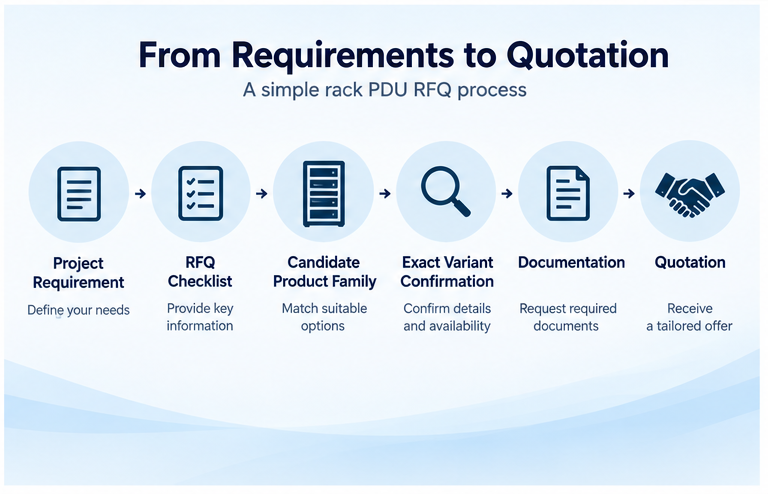
A simple procurement process is:
Project requirement → RFQ checklist → Candidate product family → Exact variant confirmation → Documentation confirmation → Quotation
The goal is not to make the supplier guess the engineering requirement.
The goal is to provide enough information for accurate product and variant matching.
Frequently Asked Questions
What Information Should I Include in a Rack PDU RFQ?
At minimum, provide the requirements already known for voltage, current, input connector, output sockets, outlet count, quantity and project context.
Rack format, cord, documentation and optional features should also be included where relevant.
Should I Specify the Input Plug and Output Sockets Separately?
Yes.
The input connector determines how the PDU receives power, while the output sockets connect the equipment.
Can I Request a 0U PDU?
Yes, you can state 0U as a project requirement.
However, current reviewed RITOKS product data does not confirm a 0U model, so availability must be checked.
Can I Request C13 or C19 Outputs?
You can include C13 or C19 as a required output format.
Current RITOKS data confirms C13/C19 modular components under RTS-PDUSM, but not a complete assembled C13/C19 PDU family.
Can I Request Metering or SNMP?
Yes, if those features are required by your project.
RITOKS now publishes separate smart rack PDU, metered rack PDU and ATS rack PDU families. Use the P Series, Local-Display Metered and LA-PD ATS pages only to verify their documented functions; the exact monitoring, protocol, transfer and configuration requirements must still be stated in the RFQ.
Can I Request Custom Packaging or OEM Branding?
You may include those requirements in the RFQ.
Current evidence does not support a universal claim that all rack-power products support private labeling or custom packaging, so availability should be confirmed by product and quantity.
Does RITOKS Calculate the Required PDU From My Server Count?
The current site does not support that claim.
Provide electrical and rack requirements already defined by the project rather than using server count as an automatic sizing input.
Do I Need a New Website Form to Send This Information?
No.
The existing RITOKS inquiry form includes a free-text requirements, quantity and specifications field where these details can be entered.
Ready to Send a Rack PDU RFQ?
A strong Rack PDU RFQ separates:
confirmed project requirements
from:
items that still require product or variant confirmation.
Before sending your inquiry, review:
input voltage
rated current
input connector
output sockets
outlet count
rack format
cord
optional feature requirements
quantity
technical documents
destination
delivery schedule
Then send those requirements together with any preferred RITOKS product family.
View Rack Power Distribution →
View Rack PDUs & Socket Modules →
Read the Rack PDU Selection Guide →
Related Resources
Continue exploring Rack Power Distribution
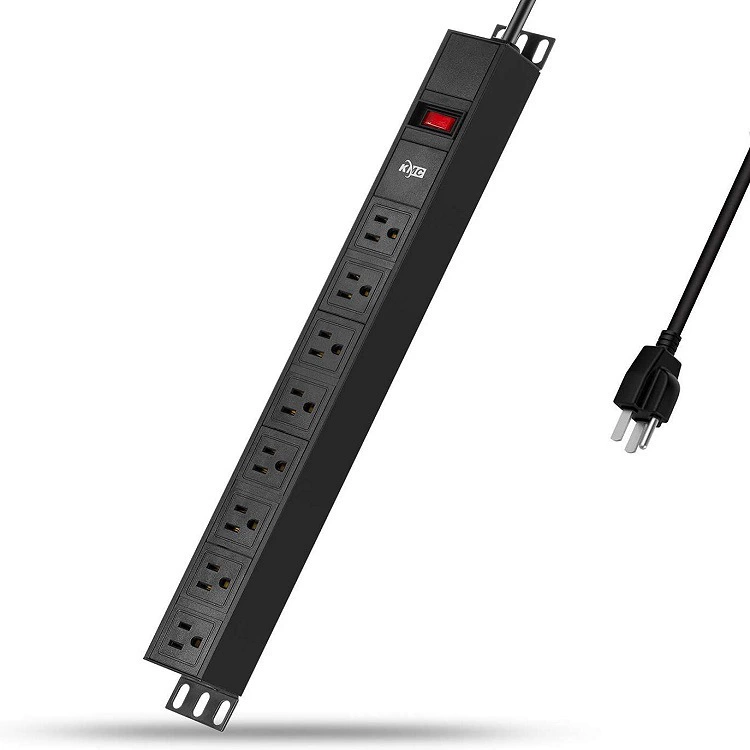
125V 8-Outlet vs 250V 1U Rack PDU: RITOKS Model Comparison
125V 8-Outlet vs 250V 1U Rack PDU: RITOKS Model Comparison RITOKS currently publishes two assembled rack PDU families…
Read guide
Rack PDU Selection Guide: Outlet Count, Voltage, Plug and Socket Format
Rack PDU Selection Guide: Outlet Count, Voltage, Plug and Socket Format Selecting a rack power distribution unit involves…
Read guide